
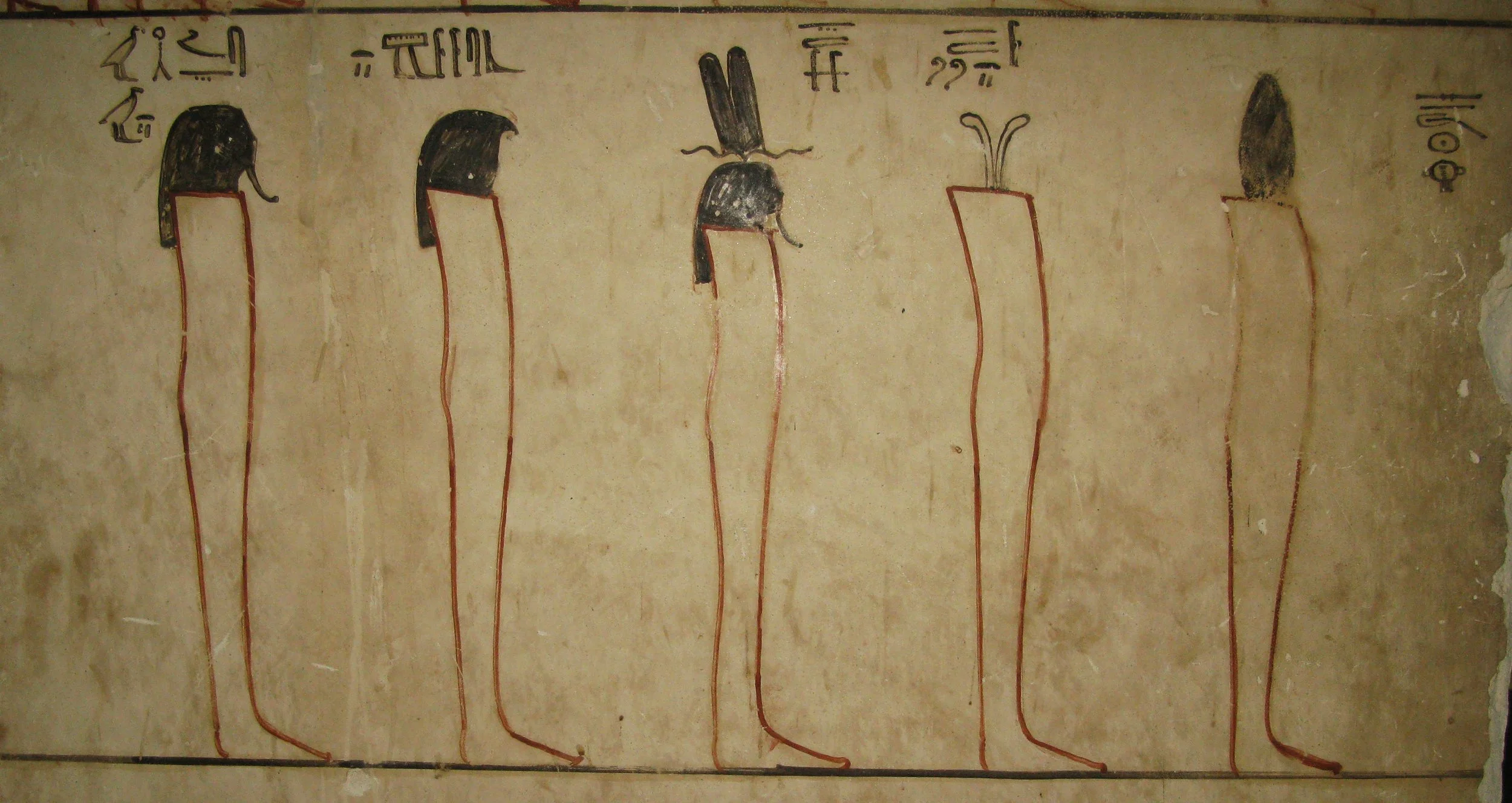
Demons of the Netherworld, Part 2 — The Forms of Re
In the Litany of Re, the “demons” of the Netherworld turn out to be the sun god himself. Meet the seventy-five forms of Re, the gate-guarding serpent and crocodile, and the strange figure called “Binder.”

Demons of the Netherworld — Knowing Their Names
When we hear the word "demon," most of us picture something out of medieval art: horned, winged, and thoroughly evil. Ancient Egypt had its own crowded population of supernatural beings that Egyptologists call "demons," but they rarely fit that mold. Many of them were neither good nor evil. They had jobs to do—guarding a doorway, watching over a stretch of road, protecting the sun god on his journey—and they did those jobs in some of the strangest bodies ever imagined: serpents striding on human legs, goddesses wielding knives, a mummy with coils of rope where his head should be.

Departed Alive: How the Ancient Egyptians Understood Death
"You have not departed dead, you have departed alive." With these words, an ancient Egyptian funerary text (Pyramid Texts Utterance 213) reassures the deceased that death is a beginning rather than an end. Death, ancient Egyptian mwt, marked the end of a physical, human life, but not the end of existence. Those who lived according to moral principles and cosmic order (maat), and who were supported by the proper rituals, could attain an eternal, blessed afterlife. In Egyptian belief, only those who had sinned against cosmic equilibrium suffered the "second death," a fate of eternal damnation and non-existence.

Praise to the Great Cat
The combination of an animal head with a human body is a distinctive feature of images of ancient Egyptian deities. Fully human or fully animal representations also appear. Amun, whose most common epithet in the New Kingdom is “king of the gods,” is most often shown in anthropomorphic form, although in Nubian temples he can have a ram head. The goddess Taweret, a protector of women and children, appears almost exclusively as a pregnant hippopotamus.