
When we hear the word "demon," most of us picture something out of medieval art: horned, winged, and thoroughly evil. Ancient Egypt had its own crowded population of supernatural beings that Egyptologists call "demons," but they rarely fit that mold. Many of them were neither good nor evil. They had jobs to do—guarding a doorway, watching over a stretch of road, protecting the sun god on his journey—and they did those jobs in some of the strangest bodies ever imagined: serpents striding on human legs, goddesses wielding knives, a mummy with coils of rope where his head should be.
The demons of the Book of the Dead, especially the knife-wielding guardians who stand at the gates of the afterlife, have been studied in detail. But one of the richest sources for Egyptian demons has received far less attention: the Netherworld Books. These compositions contain thousands of divine beings, each one drawn, named, and often described with a precise job in a precise place. In this two-part series, I will explore what these texts reveal about how the ancient Egyptians organized their divine world—where the great gods ended and the "demons" began—and why knowing a demon's name could mean the difference between being swallowed and being saved.
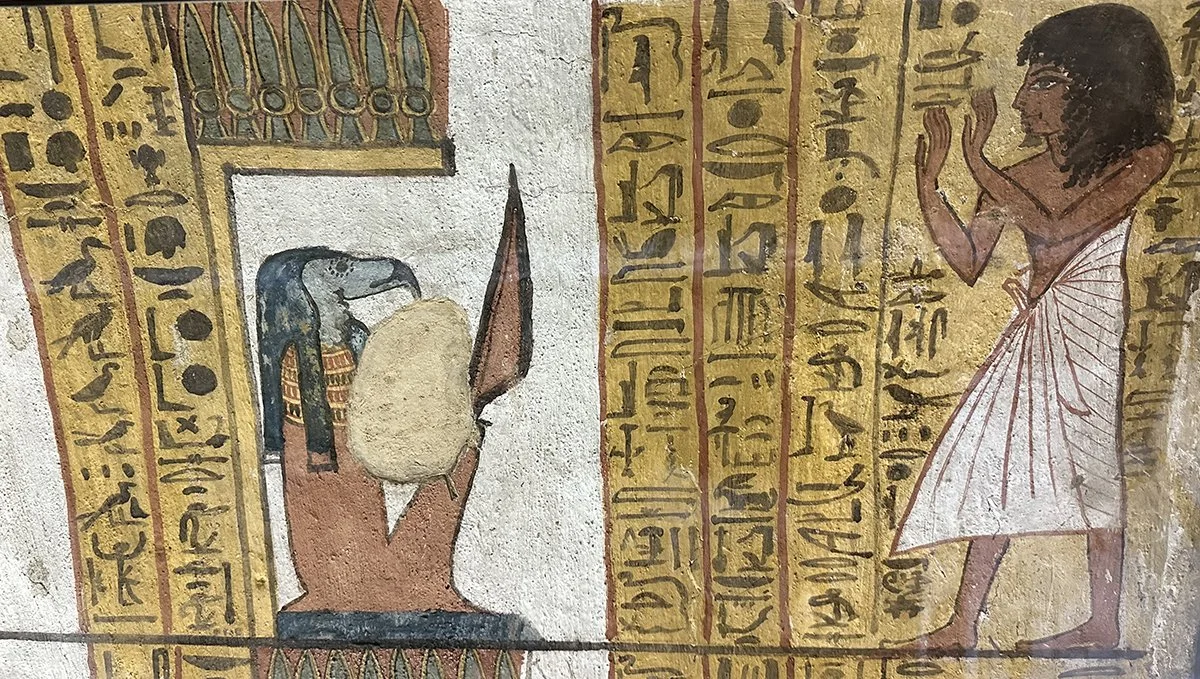
Knife-wielding demon guarding the first portal in Chapter 147 of the Book of the Dead, painting in the Tomb of Sennedjem at Deir el-Medina (by Colleen Darnell)
First, some background. When people think of ancient Egyptian funerary texts, the Book of the Dead usually comes to mind. Its ancient title was the "Book of Going Forth by Day," and its spells were designed to help an individual's soul leave the tomb and travel in the company of the sun god. Even this famous funerary application had this-worldly uses, appearing occasionally on the walls of Egyptian temples.
The Netherworld Books are something quite different. Rather than charting one person's path to paradise, they describe the voyage of the sun god Re through the twelve hours of the night. Each evening, the sun sank into the western horizon and entered the Duat, the Egyptian Netherworld; each morning, he was reborn in the east. The Netherworld Books map this nightly journey hour by hour—its landscapes, its inhabitants, its dangers—and so they are less "funerary texts" than works of cosmography: knowledge of how the universe works. In the New Kingdom, only the king, the most senior priests, and a select few had access to this knowledge.
These compositions first appear on the walls of royal tombs in the Valley of the Kings. Later, they spread beyond the king: by the Twenty-Sixth Dynasty, private individuals could combine three or more of these "books" in their own tombs, and in the Thirtieth Dynasty—the last dynasty of native Egyptian kings—selections from several Netherworld Books became a standard way to decorate massive stone sarcophagi. Four compositions survive complete: the Amduat (ancient name: Book of the Hidden Chamber), the Book of Gates, the Book of Caverns, and the Litany of Re (ancient name: Book of Adoring Re in the West). Others, like the Book of the Creation of the Solar Disk and the Enigmatic Netherworld Books of the Solar-Osirian Unity, survive in large part, but whether the extant sections represent the entirety of the composition is uncertain.
The central tension in all of these texts is the same. Will the sun god pass safely through the darkness, defeat his enemies (above all the chaos serpent Apep), and rise again at dawn? Because the sun's rebirth each morning renewed all of creation, far more was at stake than the fate of a single soul. If Re failed, the cosmos failed with him.
So what is a "demon" in such a world? They are a large class of beings who are not evil at all, but simply lesser divinities with limited powers and narrow responsibilities. We may call these beings daimones, borrowing the Greek term for "lesser divinities," which originally carried no sense of evil. In the Book of the Dead, demons share two features in particular: they are bound to a single place (such as one gate of the Netherworld), and they have physical needs—they eat, drink, and sometimes threaten to devour the dead.
When we turn to the Netherworld Books, we find hundreds of beings who can be classified as daimones, and the Book of Amduat is particularly helpful for understanding this class of deities. Some later versions titled Netherworld Books Amduat (Imy-duat), which means "That Which Is in the Duat," but the composition's ancient title was the "Book of the Hidden Chamber;" I will use the former for brevity. Amduat divides the night into twelve hours, each one both a unit of time and a region of space, and fills those hours with more than nine hundred named figures. Some are among the most famous deities of the Egyptian pantheon: Re, Osiris, Isis, Horus, Anubis, and Maat. Some are gods with a more restricted perview, like Hu ("Divine Utterance") and Sia ("Divine Perception"), who sail with Re in his boat. A few figures are not living beings at all but sacred objects—stelae, staffs, and door leaves. The vast majority, however, are beings who appear nowhere else in Egyptian religion. They may be human in form, animal in form, or (most often) a combination of the two, and the texts beside them describe their very specific duties in very specific locations.
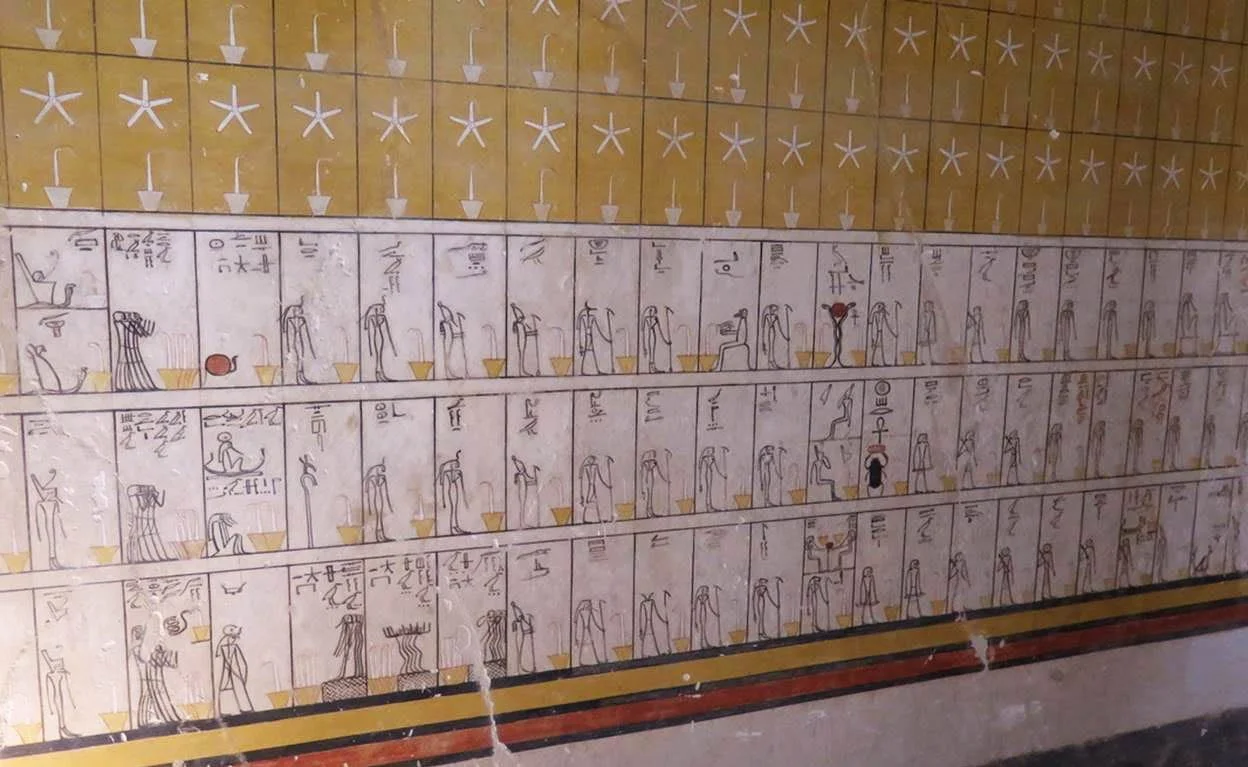
Deities from the Eleventh Hour of the Book of Amduat represented in the “Catalog” in the upper chamber of the tomb of Thutmose III (By Tripidays Egypt tours, Public Domain, https://commons.wikimedia.org/w/index.php?curid=163845524).
The Amduat is also unusual for another reason: it came with extra features that we would recognize in a modern book. It has a title, instructions for how to lay it out on the walls of a room, an abridged "summary" version (called "the Short Amduat"), and a separate catalog of all of the deities. This catalog appears only in the tomb of Thutmose III (KV 34), on the walls of the upper pillared hall. Like the Amduat itself, the Catalog is divided into twelve hours, but instead of scenes, it presents 741 individual entries. Each divine being stands in its own tall rectangle: the name above, the image below, and in front of each figure, a small cup of burning incense. Above the rows of rectangles run two more registers, each one with incense cups and stars. The twelve hours wrap around the four walls of the room one after another, so that standing in the hall, you would be surrounded by the inhabitants of the entire night.
Only one group is deliberately left out of the Catalog: the enemies. The damned, the forces of chaos, and the foes of the sun god whom Re destroys in the Amduat obviously do not deserve the acknowledgment and incense offerings of the other deities, greater or lesser they may be. The sole exception proves the rule. A goddess called "Destructrix," whose place is in the Fifth Hour, appears holding a small figure of a damned soul, and her caption explains why:
She lives from the blood of the damned, and from her provisions which the gods give.
The Egyptians, it seems, drew a clear line between the truly hostile powers of chaos and the many neutral (if sometimes terrifying) beings who kept the Netherworld running. The first group was to be destroyed; the second was to be known.
And knowing them was precisely the point. The title and introduction of the Amduat lists, in ringing repetition, the knowledge that the composition contains:
Illuminated texts of the hidden chamber,
the positions of the ba-souls, the gods, the shades, the akh-spirits, and visible forms …
To know the ba-souls of the Netherworld dwellers;
To know their visible appearances;
To know their effective spells for Re;
To know the secret ba-soul;
To know what is in the hour and their gods;
To know how he calls them;
To know the doors and the paths over which the great god passes;
To know the course of the hours and their gods;
To know the honored and the damned.
The scribes who created the Catalog borrowed this language of knowing. In the main version of the Amduat, a group of nine baboons is labeled simply: "Names of the gods who open for the Great Ba-soul (Re)." In the Catalog, the same caption becomes: "Knowing the names of the gods within the Netherworld who open for the Great Ba-soul (Re)." Captions for other groups of goddesses and gods receive the same treatment. These small edits tell us that someone was actively reworking the text, turning a series of labels into a statement of mastery of Netherworldly knowledge.
The physical layout of the Catalog strengthens that mastery. Every divine being is enclosed within rectangles, literally put in order. To the ancient Egyptians, a name was not just a label but part of a being's essence, and to know that name was to have power over its owner. Placing each name and image inside its own frame visually reinforced the control of the knowledgeable reader over every single divine manifestation in the night. Meanwhile, the incense before each figure suggests that the Catalog was not merely read but used in ritual, with the names recited aloud as offerings were made.
The Amduat itself tells us that such knowledge had benefits both in this life and the next. A passage in the First Hour, which applies to the Catalog as well, reads:
One makes these images like this image in the Hidden Chamber of the Netherworld.
The one who makes these images is the likeness of the Great God himself.
It is effective for him on earth, truly attested.
And the introduction to the Fourth Hour promises:
The one who knows this image is one who eats bread with the living in the Temple of Atum.
Drawing the images and knowing them were two sides of the same powerful act.
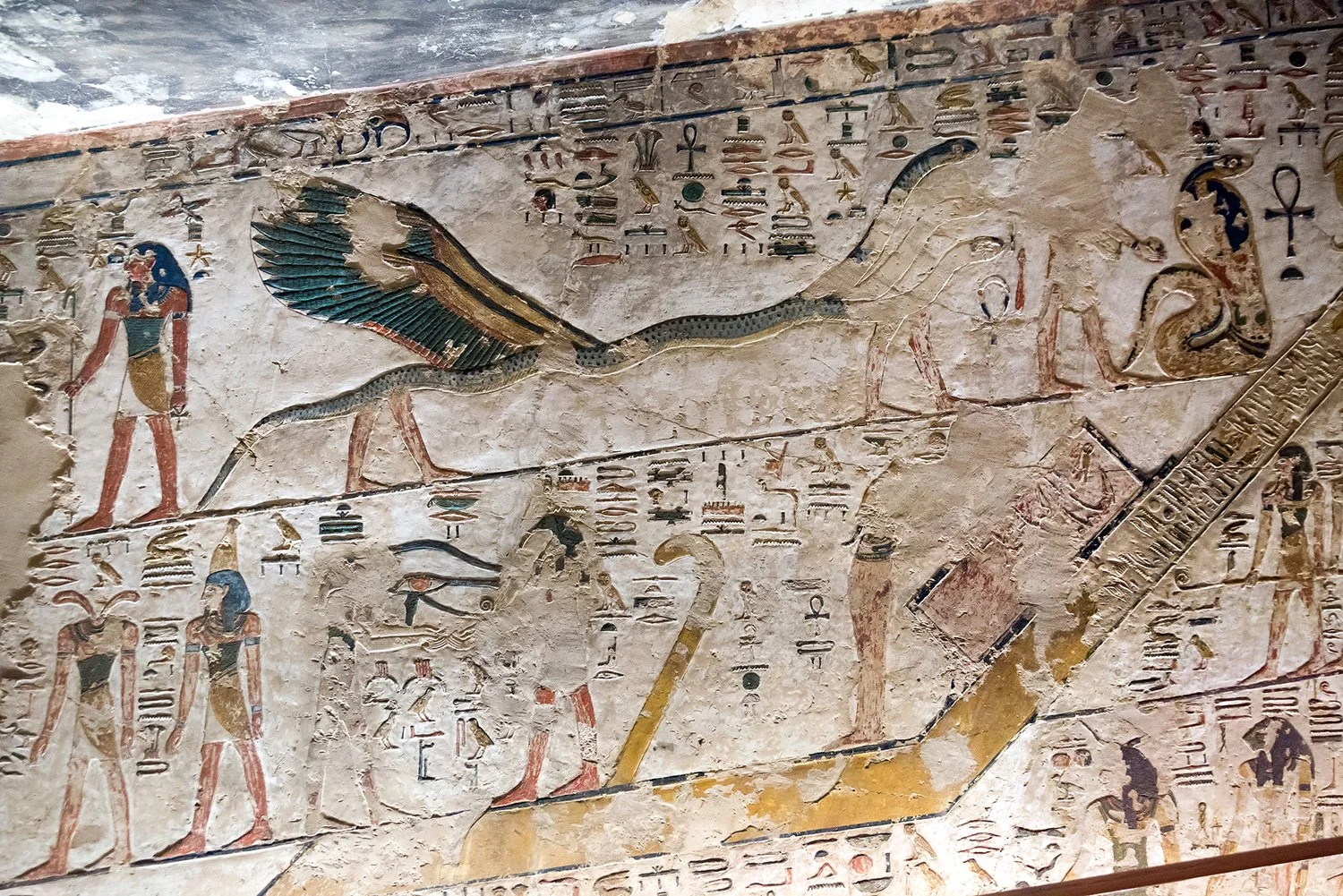
Three-headed winged serpent in the Fourth Hour of the Book of Amduat, tomb of Seti (by kairoinfo4u).
To see how "demons" fit into this system, let's travel to the Fourth Hour. The Fourth and Fifth Hours of the Amduat are called the "land of Sokar," a dry, sandy desert crossed by zigzagging paths and blocked by doors. Here, Re's boat can no longer sail; it must be towed across the sand, and it transforms into a serpent so that it can slither along. This region is populated by snakes of every description: snakes with wings, snakes with human legs, snakes with three heads.
The captions beside these serpents tell us that each is fixed to one spot. A snake named "Hidden One," in the bottom register of the Fourth Hour, is described this way:
He exists in this fashion at the entrance of the mysterious road of Imhet,
without going to any other place, every day,
for he lives from the sound of the gods who belong to this road.
Here we find both of the hallmarks of Book of the Dead demons. "Hidden One" is bound to a single location, and he has physical needs—though, in a nice twist, his sustenance is sound, the voices of the gods who pass along his road. The ancient Egyptians associated breath and speech in religious texts, and when Re spoke to the denizens of the Netherworld, he literally gave to them the breath of life.
Another serpent, in the Sixth Hour, offers a glimpse of a divine hierarchy based on the senses. His name is "Swallower of the Dead," and his caption explains that "this Great God" (Re) does not see him, but the figures held within his coils breathe when they hear Re's voice each day. In the Netherworld, the higher one stands in the divine hierarchy, the more fully one can experience the sun god. The most exalted beings see Re and hear him; others, like the beings inside "Swallower of the Dead," can only hear him pass by in the darkness.
The Catalog adds one more fascinating detail about these serpents. In most of its rectangles, the image of a deity is enough to show that it is divine. But for snakes that slither along the ground or walk on legs, the scribes did something different: they split the box in two, placing the serpent above and adding, below it, the hieroglyph of a seated god. That hieroglyph, which normally serves as a "determinative" sign that classifies a word as divine, was apparently required before a crawling snake could take its place among the other gods. Rearing cobras (the uraeus serpents worn on royal crowns) needed no such added sign.
What, then, do the beings of the Amduat teach us about Egyptian demons? Every entry in the Catalog, from the mighty Osiris to the humblest serpent guarding a road in the desert, is granted same status in this context, for each is a divine being, placed in its own frame and offered the same incense. And knowing their names is essential, not only for the king's own afterlife, but because this knowledge helped keep the sun on its course and the cosmos in order.
But the Netherworld holds still stranger figures. In Part 2, we will meet the seventy-four forms of the sun god in the Litany of Re—including some of the most monstrous images in all of Egyptian art—and discover how fearsome crocodiles and fire-breathing serpents became protectors of the sun god and of the dead.
Additional Reading
Colleen Manassa, "Divine Taxonomy in the Underworld Books," Archiv fur Religionsgeschichte 14: 47-68 (from which this blog post is adapted).
Ancient Egyptian Interconnections Vol. 25 (2020), edited by Kasia Szpakowska: Demon Things: Ancient Egyptian Manifestations of Liminal Entities.
John Coleman Darnell and Colleen Manassa Darnell, The Ancient Egyptian Netherworld Books, Writings from the Ancient World 39 (Atlanta: SBL Press, 2018).
Panagiotis Kousoulis, "The demonic lore of ancient Egypt: questions on definitions," In Kousoulis (ed.), Ancient Egyptian Demonology: Studies on the boundaries between the Demonic and the Divine in Egyptian Magic, OLA 175 (Leuven, 2011), pp. ix-xxi.
Rita Lucarelli, "Demons (benevolent and malevolent)," UCLA Encyclopedia of Egyptology 2010. , 1(1). Retrieved from https://escholarship.org/uc/item/1r72q9vv
Rita Lucarelli, "The guardian demons of the Book of the Dead”. British Museum Studies in Ancient Egypt and Sudan 15, 2010.