
Departed Alive: How the Ancient Egyptians Understood Death
"You have not departed dead, you have departed alive." With these words, an ancient Egyptian funerary text (Pyramid Texts Utterance 213) reassures the deceased that death is a beginning rather than an end. Death, ancient Egyptian mwt, marked the end of a physical, human life, but not the end of existence. Those who lived according to moral principles and cosmic order (maat), and who were supported by the proper rituals, could attain an eternal, blessed afterlife. In Egyptian belief, only those who had sinned against cosmic equilibrium suffered the "second death," a fate of eternal damnation and non-existence.
Because they believed so deeply in the immortality of the soul, the Egyptians rarely spoke of death directly. Instead, they described it in metaphors: an individual "moored," and a king "ascended to heaven." Death could also appear as an "enemy" or a "thief." Yet in a theology filled with dualism and nuance, one genre offers a surprisingly skeptical perspective on the afterlife: the "harper's songs." Their lyrics appear above harpists on tomb walls and were also written on papyri, such as British Museum Papyrus EA 10060 (also known as Papyrus Harris 500):
"Those who are buried in their pyramids, those who built their tombs. Their places do not exist—what has befallen them? … their walls have fallen, their places are no more, as if they never existed. No one returns from there … Until we go to where they have gone."
Having confronted the uncertainty of death, the song reaches a joyful conclusion, encouraging its listeners to enjoy life to its fullest: "Follow your heart and your joy!"
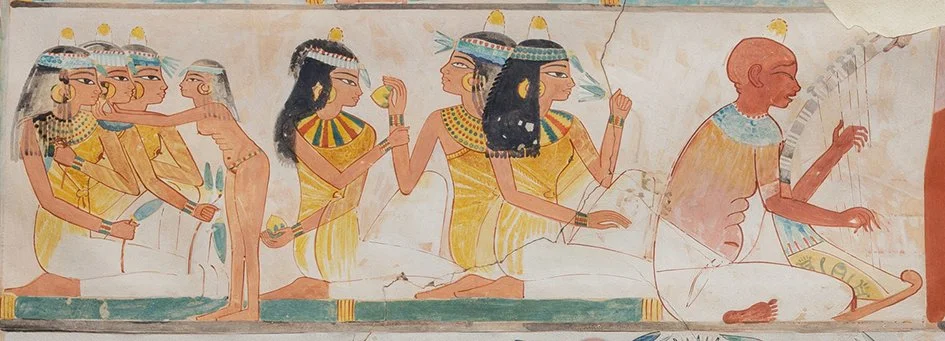
Musicians in a Banquet Scene, Tomb of Nakht (20th century copy of ca. 1400 BCE original), Public Domain
Death, of course, comes to everyone. According to ancient Egyptian belief, however, the cessation of bodily activity began a transition from the earthly, immanent realm to an otherworldly, transcendent existence. Cultic activities for the dead began with the embalming ritual and ideally continued in perpetuity after burial in the form of offerings, aiding the deceased in the passage to the other world and sustaining his or her blessed afterlife. The living also benefited from this ongoing relationship. Priests and family members who maintained the cult of the dead could ask the dead to adjudicate with potential enemies in the Underworld and mediate with divinities. On a more personal level, they preserved continued contact with departed loved ones.
For the Egyptians, a person consisted of several distinct modes, each of which could represent the totality of the individual. These were the body or corpse (khat), the shadow (shut), the heart (ib), the name (ren), and three spiritual components: the ba, the ka, and the akh. At death, each aspect of a person's identity met a different fate, with the earth belonging to the corpse and the ba belonging to the sky. Properly executed rituals, however, initiated a process of reunification, both among the aspects of the person and with the family and society from which death had isolated the individual.
The ba-soul, a personalized and mobile element, was depicted as a bird with the head of the individual. The ba embodied freedom of movement in the afterlife, and it existed as a pair with the corpse. Book of the Dead Chapter 89 expresses this bond: "May it (the ba) look upon his corpse, may it rest upon his mummy, may it never be destroyed or perish forever."
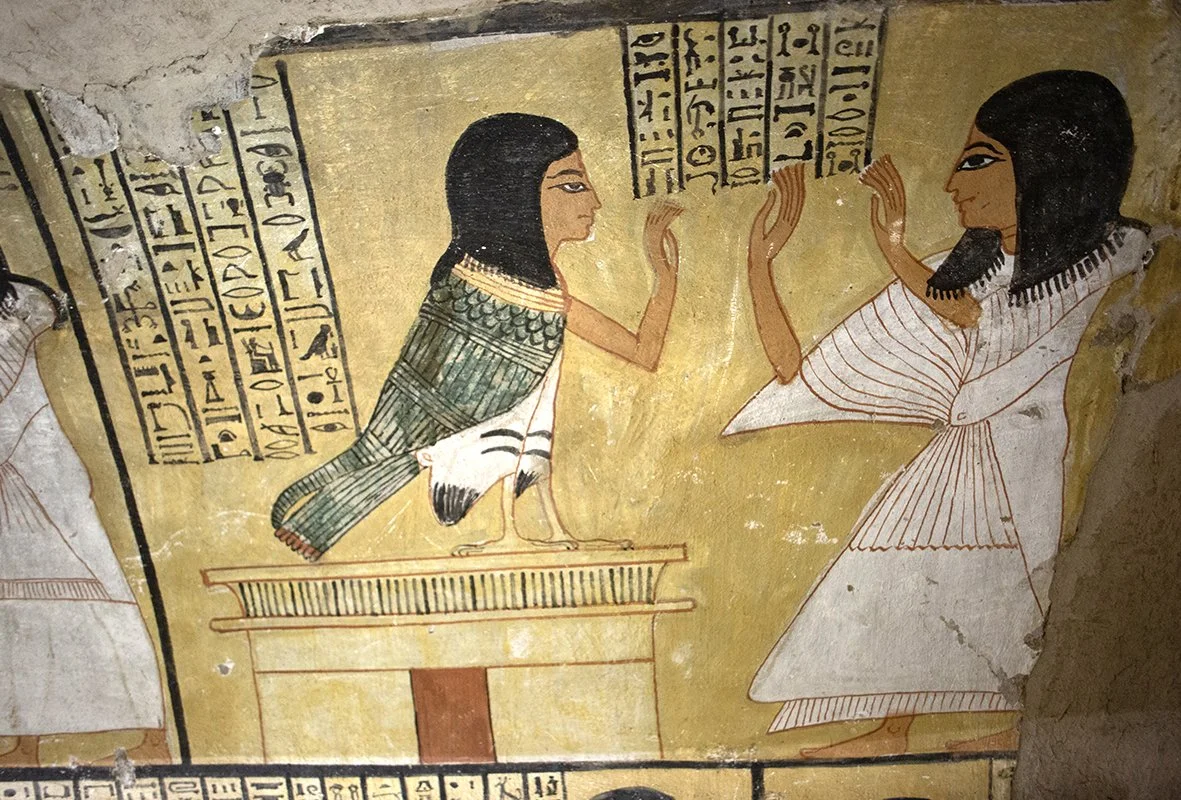
Foreman in the Place of Truth and Overseer of the Works in the Place of Eternity Inherkhau worshipping his own ba-soul (Theban Tomb 359, ca. 1170 BCE), photograph by Colleen Darnell
The ka-spirit was a person's double and social component, re-integrated with the deceased's family and friends after the disruption of death. Death itself could be called "going to your ka-spirit." Tellingly, another word, ka, meaning "food" or "provisions," was written with the same hieroglyphic sign as the ka-spirit. In the tomb of Ahmose, son of Ibana (ca. 1475 BCE), the deceased reaches toward an offering table piled with food and the hieroglyph for the ka-spirit. The food nourishes his soul.
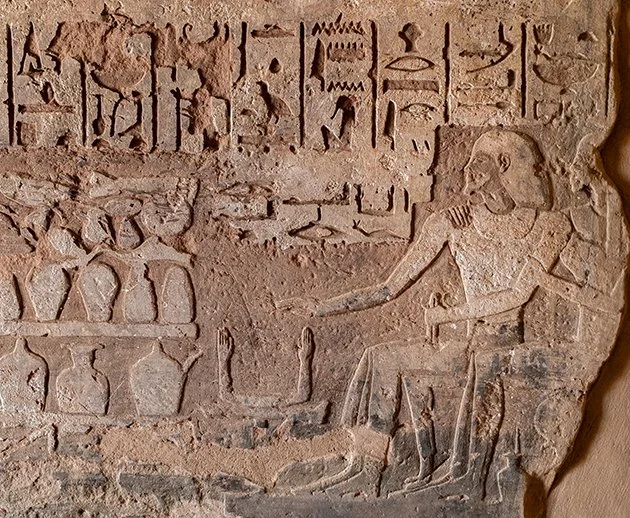
Offering scene in the tomb of Ahmose, son of Ibana, Elkab (ca. 1475 BCE), photograph by Alberto Urcia and Elisa Brener
The third spiritual element, the akh, or transfigured soul, brings us closest to what we might call a ghost. Its name relates to two concepts: effectiveness and luminosity. One of the Egyptian words for magical spells was akhu, and the akh of a deceased person was powerful, because it could affect the living in both positive and negative ways. A dead person's akh could intervene to help family members, particularly those under attack by spiritual enemies, or even by other rogue akh-spirits. In a letter written by a mother to her dead son, she tells him: "You are effective (akh) upon the earth; you are potent in the necropolis." In its luminous aspect, the akh relates to the sun god Re, whose movements through heaven and earth provided the template for human resurrection.
Religious texts describing the experiences and journey of the deceased in the afterlife abound in ancient Egypt, spanning a three-thousand-year tradition of composition and copying. The Pyramid Texts, Coffin Texts, and Book of the Dead contain instructions for funerary rituals, knowledge required to attain a blessed afterlife, and descriptions of the topography of the Underworld. These funerary texts offer numerous divine templates for death and resurrection, most prominently Osiris, lord of the Underworld, and Re, the solar creator deity. The union of Re and Osiris is the greatest mystery of Egyptian religion, containing the power to resurrect the deceased as well as recreate the cosmos. For all their diversity, these texts shared a single purpose within a burial: transforming a deceased person into an akh. Sequences of these compositions could even be entitled sakhu, "transfiguration spells" (literally, "that which creates an akh-state").
A different set of religious texts, the Underworld Books, were not personal guides to the afterlife. Instead, they described the hidden workings of the cosmos and the sun god's journey through the twelve hours of the night. In their first attestations, the Underworld Books appear in royal tombs, part of the ritual knowledge entrusted to the king in his role as chief solar priest. These compositions reveal that the afterlife had no single geographic location: the Underworld existed both in heaven and beneath the earth. Ultimately, the realm of the dead, the West where the sun traveled each night, lay beyond the created cosmos. It was therefore ineffable and indefinable from a living human's perspective.
Egyptian texts suggest that death should ideally occur within the boundaries of Egypt, and burial close to one's hometown was desirable. A tomb near one's family encouraged the perpetuation of the deceased's mortuary cult. The soul itself, however, did not dwell permanently in the tomb, contrary to the common description of the Egyptian tomb as a "house of the dead." The ultimate destination of the deceased was a different world altogether, an alternate universe in direct contact with the chaotic, undifferentiated waters of creation. Only through contact with these powerful, creative forces could the dead be reborn into their eternal afterlife.
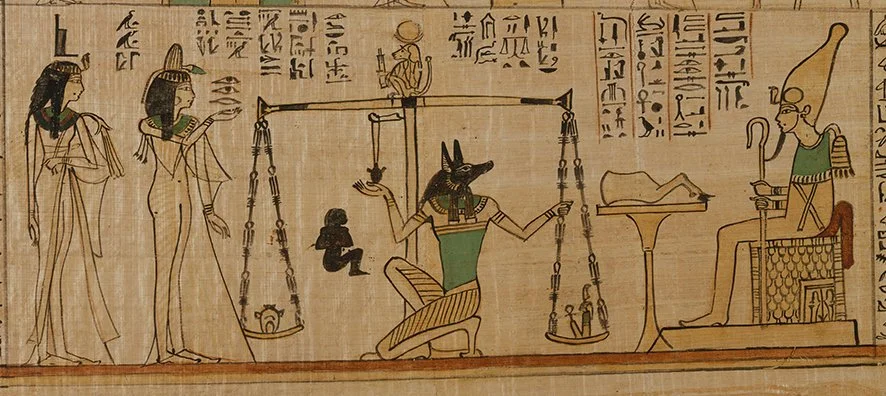
Book of the Dead of the Songstress of Amun Nany, showing the Weighing of the Heart from Chapter 125 of the Book of the Dead (ca. 1050 BCE), Metropolitan Museum of Art 30.3.31 (Public Domain)
Despite all the physical trappings of mummification and burial, the Egyptian afterlife possessed a strong moral character. The story of Setne Khaemwaset and Si-Osire offers a rare insight, contrasting the fates of two men. One is rich and buried in the most lavish style. The other is so poor that no one mourns at his funeral. In the Underworld, the poor man, who lived a moral life, is dressed in the finest linen and enjoys a lavish banquet beside Osiris. The rich man, who lived an immoral life, is condemned to eternal torture, with the pivot of a door forever turning in his eye socket. Every spirit underwent judgment, visualized as the weighing of the heart. As the tale of Setne Khaemwaset so eloquently expresses, one's inner character, not one's material possessions, tipped the scales.
If you want to learn more about the restless dead of ancient Egypt, register for GHOSTS OF ANCIENT EGYPT, a live, remote class that I teach on Zoom.
Further Reading
Jan Assmann, Death and Salvation in Ancient Egypt (Ithaca: Cornell University Press, 2005).
John Coleman Darnell and Colleen Darnell, The Ancient Egyptian Netherworld Books (Atlanta: SBL Press, 2018).
John H. Taylor, Death and the Afterlife in Ancient Egypt (London: British Museum Press, 2001).