Archery in Ancient Egypt
The bow and arrow is one of the first weapons ever depicted in the hands of Egyptian warriors, and throughout pharaonic history, bow-troops remained central to the Egyptian military. From the earliest periods of Egyptian history until the beginning of the New Kingdom, Egyptian and Nubian archers fought on foot. From the early Eighteenth Dynasty, a new type of archer appears—the chariot warrior. The introduction of the chariot into the Egyptian army occurred shortly after another key technological innovation: the composite bow. Until about 1700 BCE, the Egyptian army relied solely on “self-bows,” single staves of wood to which a bowstring is attached. The composite bow was more sophisticated than the simple bow and had much greater penetrating power. Composite bows were also more time-consuming and expensive to manufacture than the self-bow, so the simpler weapon continued to be used long after the introduction of the new technology.
The Egyptians and Nubians employed two major types of self-bows: the “segment” self-bow, in which the profile of the wood is a single curve, and a slightly more complicated and powerful bow with a double curved profile, in which the tips curve away from the bow-string. These bows ranged from 1 to 2 meters in length and had a range of 80 to 100 meters, typically fired in a volley. Nubian troops were particularly vaunted as archers.
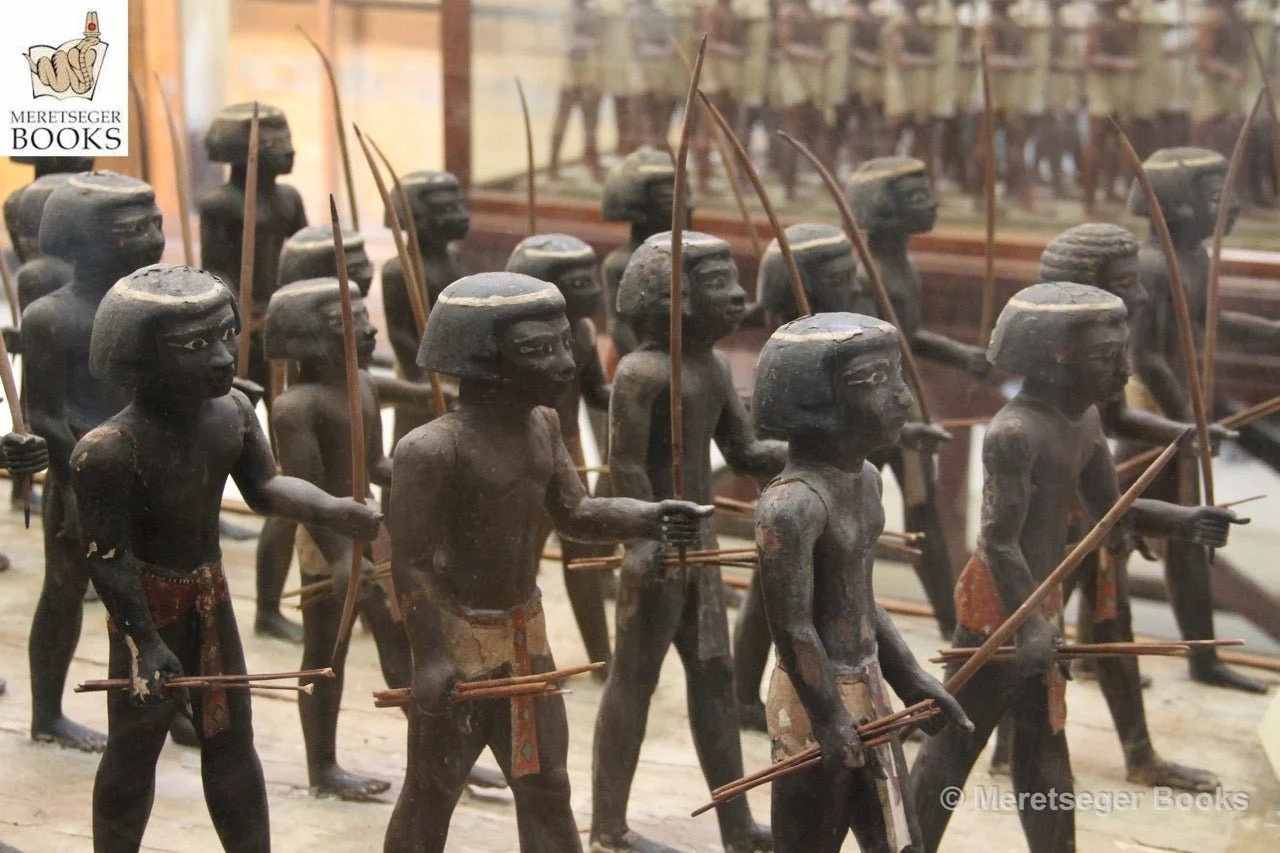
Model of Nubian Archers from the Tomb of Mesehti (Asyut, ca. 2000 BCE), Courtesy of www.meretsegerbooks.com
The manufacture of either type of self-bow was a straightforward process and used locally available woods, like acacia. After an appropriate piece of wood had been cut to the desired size of the bow, the shaft was shaped with an adze. Grooves were cut perpendicular to the shaft on one side near the ends; made pliable with steam, the wood was bent in the areas of the scoring in order to provide the curves at the two ends of the bow. After the bow had dried and the wood properly cured, probably within some sort of frame in order to provide the final shape, the bowyer cut the string notches and achieved the final smoothing of the shaft with small sandstone smoothing blocks, the equivalent of modern sand-paper. Once the bow was ready to use, it would be strung with twisted strands of animal gut.
Composite bows were constructed, as the name suggests, by gluing together different pieces of wood, horn, and sinew in order to provide many more pounds of pull. The range of composite bows as far as 170 meters, with accurate shots possible at 80 meters. Each material had to be carefully shaped to insure a proper fit in the overall construction of the bow. During each stage of the gluing process, the bowyer had to wait until the glue was dry before moving onto the next stage. After the composite materials were properly fused, the bow would be finished much like a self-bow. Two different shapes of composite bow appear in the Egyptian arsenal: recurved and triangular. The triangular bow appears in the hands of tribute-bearers from the Levant, as depicted in tombs from the reign of Thutmose III, and was used by the king himself.
The shafts of Egyptian arrows were reeds or wood (including acacia, boxwood, ebony, and spruce). The arrow-heads were most often pointed, at times barbed, causing deep wounds; the materials for arrow-heads include flint, horn, wood, bone, or copper. By the time of the New Kingdom, bronze arrowheads were in common use, although many troops, particularly Nubian auxiliaries, continued to use flint-tipped arrows. Although the Egyptians were well acquainted with poisonous serpents, their venoms, and their antidotes, only slight evidence for poisoned arrows exists. As like most pre-modern arrows, those of the ancient Egyptians were fletched with bird feathers. Arrows were carried in quivers, slung across the back for foot archers or attached to a chariot.
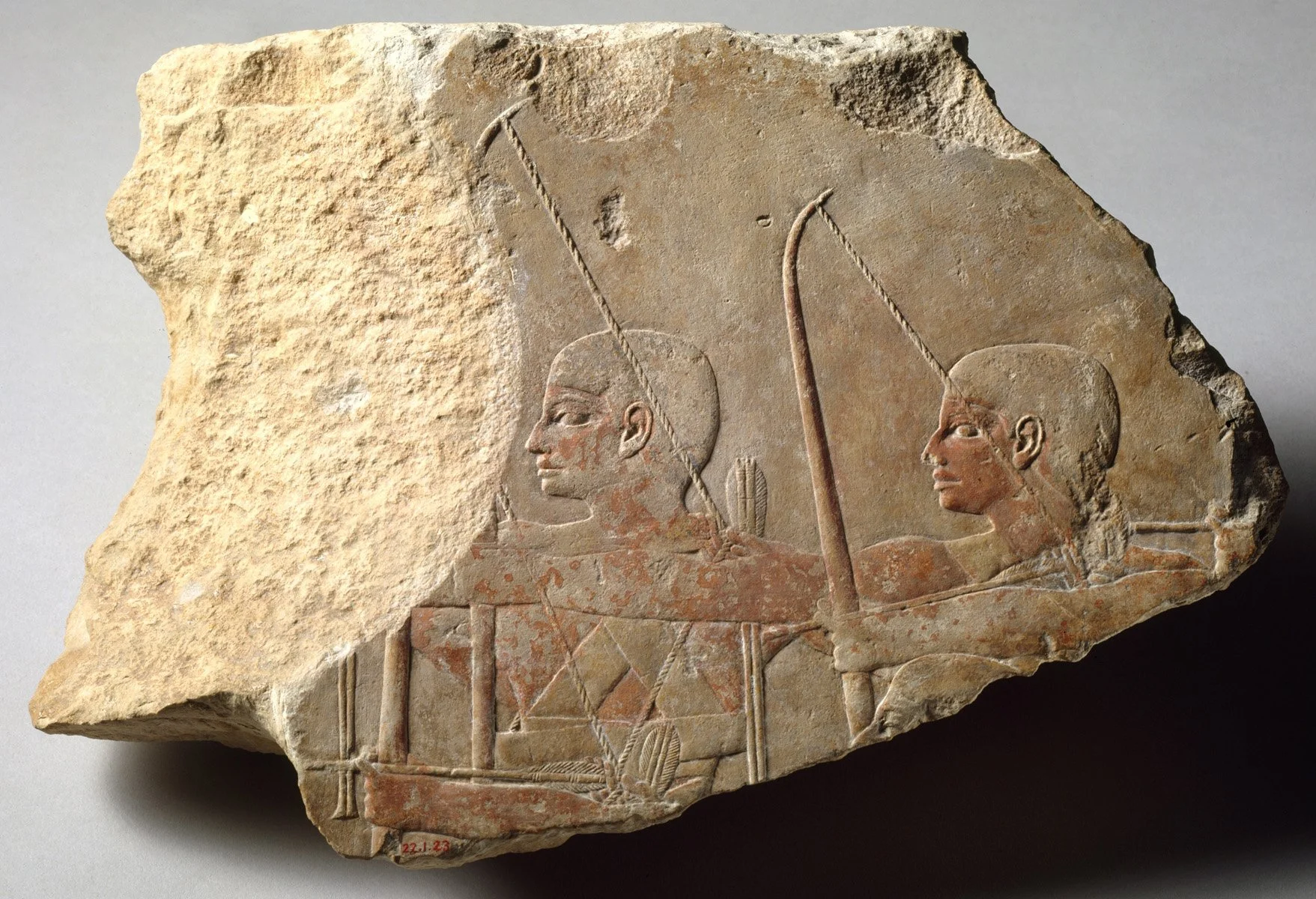
Old Kingdom relief of archers, 4th Dynasty (ca. 2551–2494 BCE), Metropolitan Museum of Art 22.1.23
Quivers were in use already by the Old Kingdom and in the Middle Kingdom bows and arrows could also be carried in large leather sleeves, open at both ends. By the New Kingdom quivers had achieved a more wide-spread use by archers on foot and in chariots, probably due to increased Egyptian activities in humid climates and the coeval rise in importance in the composite bow. Bow cases for the composite bow conformed to the triangular shape of the weapon, and attendants of infantry archers are sometimes shown carrying bows in such cases made of leather, and similarly shaped cases were attached to the sides of chariots. Most quivers of the New Kingdom were slightly tapered leather containers with a cap to keep the arrows protected.
A final, but essential, piece of equipment for the Egyptian archer was the wristguard, which protects the skin along the inside of the arm holding the bow from the snap of the bowstring. Although wristguards are probably as old as archery itself, the first Egyptian depictions of wristguards appear during the Old Kingdom (ca. 2250 BCE), and particularly well-preserved examples were buried with early Middle Kingdom soldiers. Detailed reliefs show the Egyptian pharaoh wearing a wristguard as he fires his bow, but can also appear on the wrist of the king in heraldic smiting scenes. This use of the wristguard alone to evoke the king’s prowess in archery finds expression in an elaborate jeweled gold wristguard of the pharaoh Ahmose. More practical examples of wristguards survive from the tombs of private and royal individuals of the Eighteenth Dynasty. Leather wristguards were found in the tomb of Tutankhamun and several objects in his tomb show the pharaoh wearing elaborately decorated wristguards.
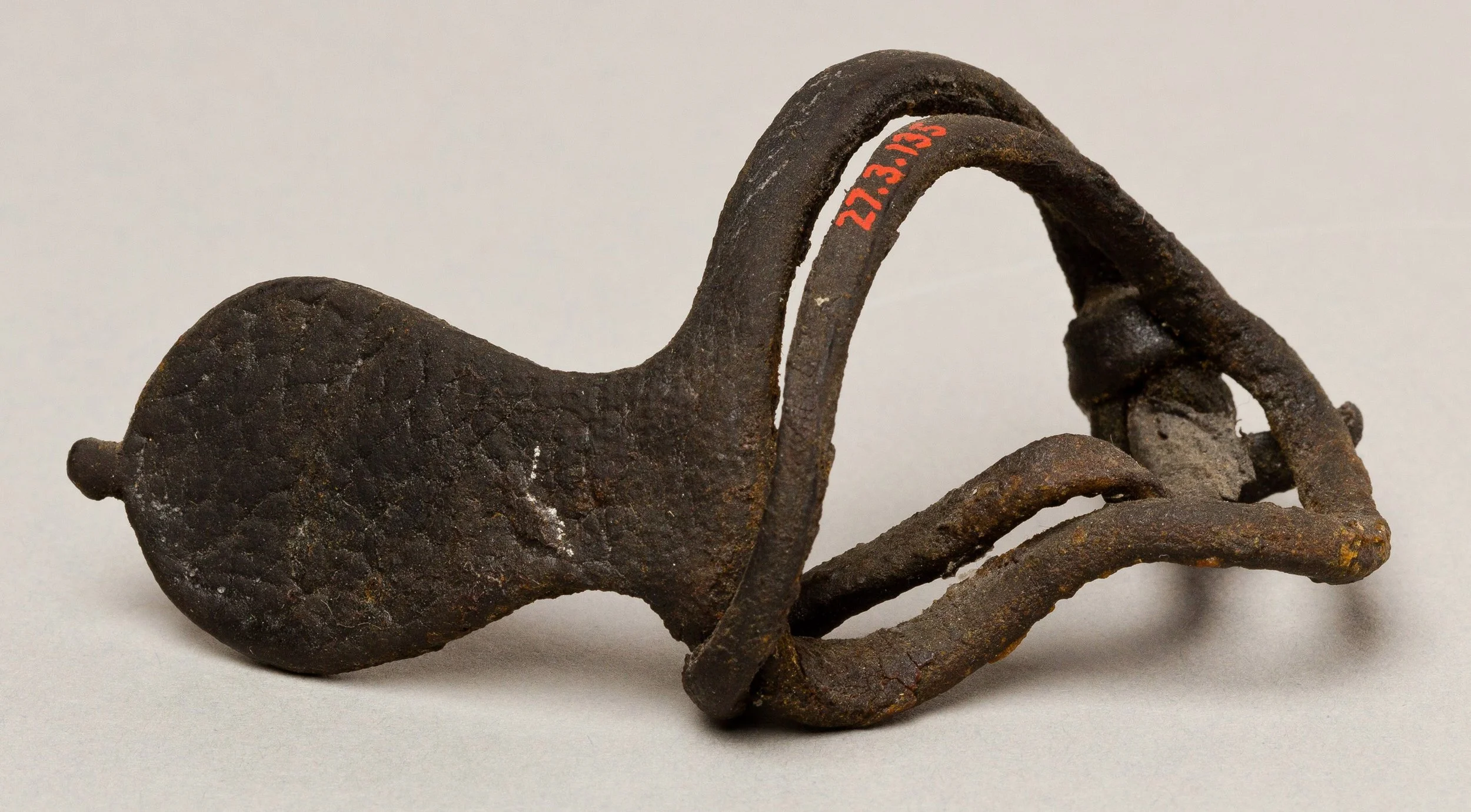
Leather wrist guard, ca. 2000-1950 BCE (Metropolitan Museum of Art 27.3.135)
The different types of bows and arrows used by the Egyptian army of the Eighteenth Dynasty were also determined by the type of force using them. The fast-moving chariot archers who raced along the front of the enemy force needed the extra penetrating power of the composite bows. Since charioteers were often drawn from the higher echelons of society, they would have been able to afford the more expensive equipment. The infantry archers, on the other hand, shot at a much higher trajectory and their strength lay in numbers—factors more suited for a self-bow. Foreign auxiliaries, such as the Nubians and Libyans, used Egyptian bow types in addition to those peculiar to their own cultures.
The tomb of Tutankhamun contained 14 self-bows, all of the more complex double-curved shape, and about 30 composite bows. Three of the self-bows from the tomb of Tutankhamun are almost two meters in length, and all but one of the others measure between 1.2 and 1.8 meters in length. The remaining bow is just over 65 cm in length, leading scholars to speculate this may have been a weapon of the “boy king” when he truly was a boy. Some of Tutankhamun’s bows consist of simple wooden staves, while some of the composite bows are elaborately gilded and decorated. The tips of one composite bow are even carved and painted to resemble bound enemies, whose necks serve as the indentation where the bowstring was tied. Each time the king drew his bow he symbolically strangled his foes.
A scene of foreign members of the Tutankhamun’s bodyguard from Luxor Temple suggests that the longest and shortest of Tutankhamun’s self-bows bows may in fact relate not to the size of the user so much as to his ethnic identity. In the Luxor Temple scene, one Nubian soldier carries a long bow, approximately 1.5 meters in length based on size of the soldier, which would correspond to the longest of Tutankhamun’s bows. A nearby Libyan soldier carries a bow only half as long as that of his Nubian compatriot. Other depictions of Libyan troops suggest that they favored these shorter bows, and the smallest bow from the tomb of Tutankhamun may be of the same type as those carried by his Libyan bodyguards.
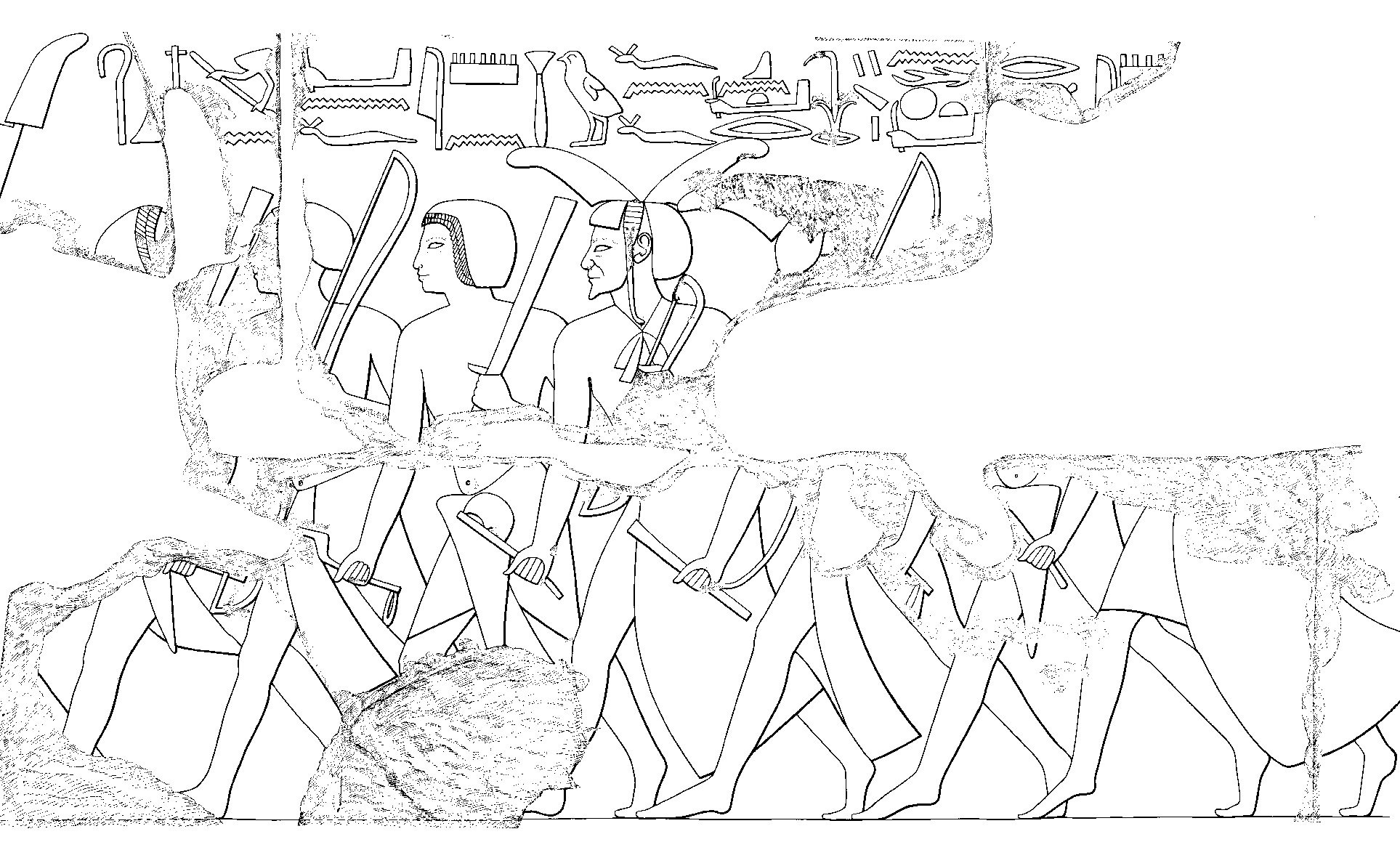
Egyptian, Nubian, and Libyan soldiers running in the Opet Procession, The Epigraphic Survey, Reliefs and Inscriptions at Luxor Temple, Volume 1: The Festival Procession of Opet in the Colonnade Hall (Chicago: Oriental Institute, 1994), pl. 93.
The different bow lengths used by the Egyptian army and its foreign auxiliaries were also suited to different purposes. The long self-bows (1.5 meters and above) would not lend themselves well to firing while moving, either on foot or mounted, but would be ideal for use by a stationary unit firing high in order to lay down a barrage of arrows, a tactic well-known from the English archers in the Hundred Years War. The short bows (less than 70 cm), like those carried by the Libyans, could be used in rapid maneuvers and are more suited for shorter ranges. The expensive and powerful composite bows, which could range in size from 1.4 meters to 70 centimeters long, were ideal for chariot archers and smaller units of foot-archers.
If you want to learn more about ancient Egyptian military history, register for ANCIENT EGYPTIAN MILITARY HISTORY, a live, remote class that begins March 3.
Further Reading
This text first appeared in J.C. Darnell and C. Manassa, Tutankhamun's Armies: Battle and Conquest in Ancient Egypt's Late 18th Dynasty (Hoboken, NJ: John Wiley & Sons, 2007), pp. 70-73.
W. McLeod, Composite Bows from the Tomb of Tutankhamun (Oxford: Griffith Institute, 1970).
W. McLeod, Self Bows and Other Archery Tackle from the Tomb of Tutankhamun (Oxford: Griffith Institute, 1982).