
King Ahmose was the first pharaoh of the 18th Dynasty, a distinction he attained by expelling the foreign Hyksos Dynasty that had ruled northern Egypt for the previous century. In the years around 1550 BC, king Ahmose’s army successfully besieged the Hyksos capital of Avaris. The autobiography of a solider named Ahmose, whose father, Ibana, had also been a soldier, describes that prior to the siege he “followed the sovereign (may he live, prosper, and be healthy!) on foot behind his maneuvers in his chariot.” This is the first mention in ancient Egyptian of a chariot being used during battle. Besides the royal chariot, no other vehicles—Egyptian or Hyksos—are mentioned, so we cannot speak of a chariot force or tactics during this nascent phase. The Hyksos may have fielded some chariots in the battle.
The light two-wheeled chariot was the ultimate war machine of the era, and it arguably reached its greatest refinement in ancient Egypt. Chariots were also used in non-military contexts for hunting and as a prestigious form of transportation; during the reign of Akhenaten and Nefertiti, chariots become important vehicles for ritualized travel. Reconstructions suggest that Egyptian chariots could weigh as little as 30 kilograms, certainly light enough for a man to carry. The chariot cab had a roughly D-shaped floor made of rope or leather mesh, which acted as a shock absorber and enhanced the accuracy of the archer, who, along with the shield-bearer (who was also the driver), made up the chariot crew. To accommodate the two-person crew, chariot cabs were typically about 1 meter wide and 0.5 meter deep, and the axle projects a little over 0.5 meters to either side of the cab.
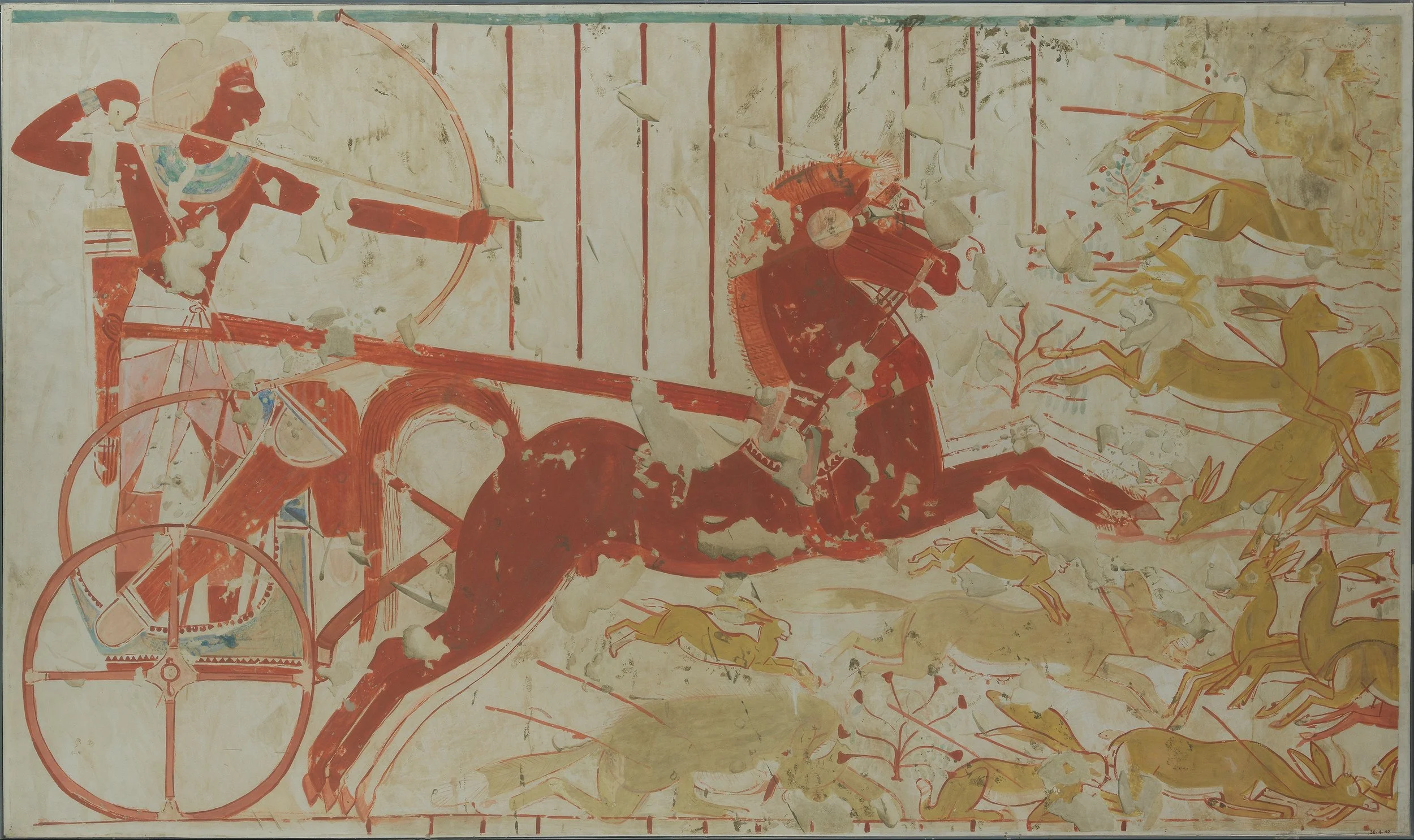
Facsimile (by Charles K. Wilkinson) of a painting in the tomb of Userhat (TT56), showing him driving a chariot during a desert hunt. CC0.
The Egyptians mounted the spoked wheels at the back of the chariot cab, enhancing stability and maneuverability. Four-spoked wheels were common in the earliest Egyptian chariots, and by the middle of the 18th Dynasty, six-spoked wheels had become standard. Each part of the chariot wheel was carefully shaped and fitted to ensure maximum strength. The wooden rim was protected by an additional outer wooden or leather “tire” that would have been particularly useful when maintaining the vehicles on campaign. Cabs included a rail at about waist height that could be partially closed with wood or leather siding; a cut-out in the siding functioned as a handgrip, and a bow case and quivers were affixed to the chariot’s sides.
The horses were harnessed to the chariot with yoke saddles attached to each side of the pole that ran beneath the body of the chariot. In addition to the bridle, bit, and reins that gave the driver steering and braking controls, straps in front of the horses’ chests and girths provided an effective traction system and prevented the horses from backing out of their harnesses. The entire system was designed to make for a fast, stable, and maneuverable machine. Decorated cloths affixed to the horses’ back provided light protection; royal chariot horses wore elaborate trappings, including gilded headpieces with multiple ostrich feathers.
The light Egyptian chariots carried two men: a warrior and a shield-bearer. Chariot warriors were often of high rank. Prominent examples include Yuya, “master of the horse,” whose daughter Tiye married king Amunhotep III , and Aye, likely from the same family as Yuya, who held the same title and who ascended to the throne after the death of Tutankhamun. In the 19th Dynasty, some of the many sons of king Ramesses II fought alongside their father as chariot warriors. Shield-bearers were of lower rank and may have been cadets; they were the main drivers of the chariot, especially during combat. The division of duties left the chariot warrior free to shoot his composite bow, or more occasionally throw javelins or wield a sword. The construction of the chariot and the makeup of its crew created a fast-moving platforms for ranged weapons.
The Egyptian chariotry was organized into groups of fifty, a structure mirroring the infantry. During the 18th Dynasty, a hierarchy of officers developed. The titles “master of the horse” and “chief of the stables (of his Majesty)” emphasized the administrative infrastructure for the chariotry. During the reign of Amunhotep III and the following Amarna Period, new titles appeared, providing chariotry equivalents to infantry ranks, such as “lieutenant general of the chariotry” and “first chariot officer.”
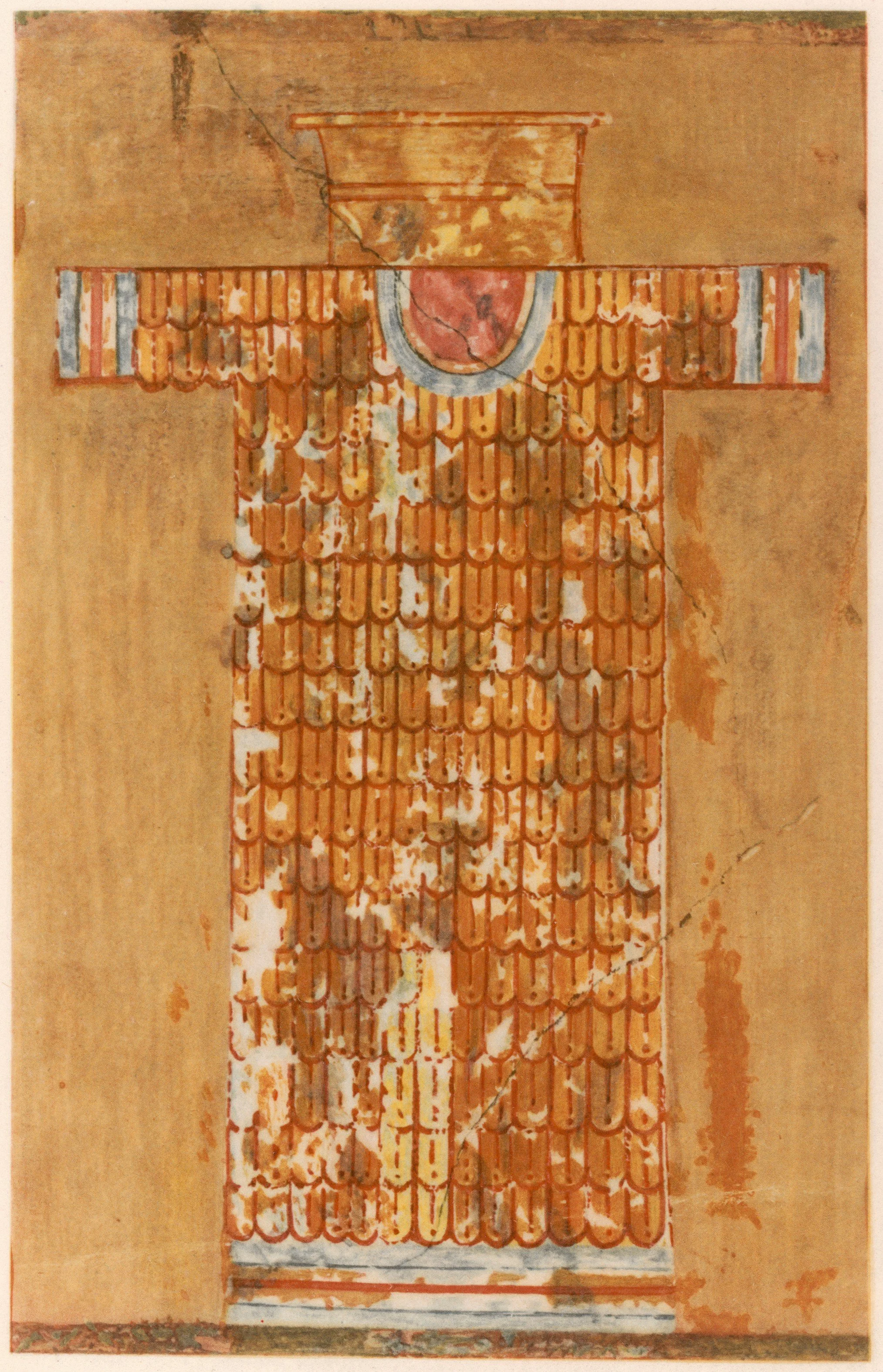
No scene of Egyptian chariotry shows any crew member wearing armor, although charioteers from the southern Levant are sometimes shown in scale armor. A depiction from the tomb of Qenamun, a contemporary of Amunhotep II, suggests that such armor did exist in Egypt. Among items being presented to the pharaoh is a set of body armor, closely resembling the contemporaneous body armor found in a Mycenaean tomb in the village of Dendra in Greece. The Dendra panoply combines a heavy neck guard and helmet, which provided considerable upper-body coverage, while mostly neglecting the legs. This would be appropriate for a charioteer who traveled in, and whose lower body was protected by, the chariot. The shield-bearer, on the other hand, was normally lightly attired, since he could shelter himself behind the shield or crouch behind the body of the chariot, with the warrior able to take the reins.
The discovery of a cache of cuneiform tablets at the Egyptian city of Amarna, ancient Akhet-Aten, provides unparalleled insight into the role of chariots as prestige items. The introductions to most letters between the “Great Powers”—Egypt, Mitanni, Assyria, and Babylonia—inquire after the health of the king himself, his wives and family, and his chariot horses. All of the “Great Powers” possessed these units of chariotry, and their creation and upkeep necessitated a significant outlay of resources. Physical infrastructure—grazing land, stables, training fields—was supported by a corps of specialists: breeders, grooms, and, of course, drivers. Chariot horses required extensive training, and the production of chariots also required investment in wood, leather, and skilled artisans. Chariots were made predominately of elm, willow, and ash, and the Egyptians appear to have understood the properties of different woods and combined them within relatively small parts of the chariot—the nave of the central portion of a wheel might have a composite construction of elm and tamarisk.
Among the chariot warriors, the most striking were probably the maryannu, elite equestrians who fought for the kingdom of Mitanni in northern Mesopotamia. The term maryannu probably derives from an ancient Sanskrit term for ‘young man’ or ‘hero’ and, in the Hurrian world, appears to have designated an important class of ‘knight,’ who was paid for his services and given authority over territory, similar to a feudal system. Egyptian texts often highlight the capture of small numbers of maryannu, which was equivalent to the capture of a high-level military official, and whose loss would be greatly felt. The reputation of these warriors led charioteers in Egypt and elsewhere sometimes to adopt the mode of dress and even hairstyle of the maryannu. Egyptian charioteers could wear their hair in three pigtails or grow beards in imitation of the foreign charioteers they hoped to defeat on the battlefield.
The chariotry arms of Late Bronze Age armies were particularly vulnerable to difficult topography. In addition to war chariots, the Egyptian army also marched with two-wheeled supply wagons. Normally, these wagons were drawn by donkeys, and heavier carts pulled by oxen were utilized in extraordinary circumstances, such as when Thutmose III transported prefabricated boats to the banks of the Euphrates to strike at the heartland of Mitanni. The lighter transport carts may have been used to supply chariots on the battlefield, bringing water and ammunition to the men and horses engaged in combat.
As the 18th Dynasty progressed, the successors of king Ahmose would lead entire chariot and infantry forces into battle. Stay tuned for more posts about those battles and how chariots played a key role in major New Kingdom Egyptian victories. If you are fascinated by ancient Egyptian military history, sign up for my newsletter to be the first to learn about upcoming live, remote classes, including topics related to warfare.
Further Reading
John C. Darnell and Colleen Manassa, Tutankhamun’s Armies: Battle and Conquest in Ancient Egypt’s 18th Dynasty (Hoboken, 2007).
Roberto A. Díaz Hernández, “The Role of the War Chariot in the Formation of the Egyptian Empire in the Early 18th Dynasty,” Studien Zur Altägyptischen Kultur 43 (2014): 109–22.
Colleen Manassa, “Two Unpublished Memphite Relief Fragments in the Yale Art Gallery,” Studien zur Altägyptischen Kultur 30 (2002): 255-267.
André J. Veldmeijer and Salima Ikram, eds., Chasing Chariots: Proceedings of the first international chariot conference (Cairo, 2012).