
In Part 1, we explored the "Catalog" of the Book of the Hidden Chamber (Book of Amduat) in the tomb of Thutmose III, where hundreds of divine beings—from Osiris to a serpent who feeds on sound—each stand in their own enclosure, receiving incense and waiting to be known by name. Now we turn to another Netherworld Book, one whose "demons" turn out to be none other than the sun god himself.
The composition commonly called the Litany of Re had a longer and more descriptive ancient title: the "Book of Adoring Re in the West," and I will use both here. The "West" is a euphemism for the realm of the dead, which can designate the entire Netherworld; for example, Osiris often bears the epithet "Foremost of the Westerners." The "Book of Adoring Re in the West" first appears in the tomb of Thutmose III—on his funerary shroud and in his burial chamber—and in the tomb of his vizier Useramun. The text has two main parts. The first, called the Great Litany, is an illustrated hymn to seventy-five forms of the sun god in the Netherworld. The second part consists of seven further litanies in which the king identifies himself with a single, unified god who is at once Re and Osiris.
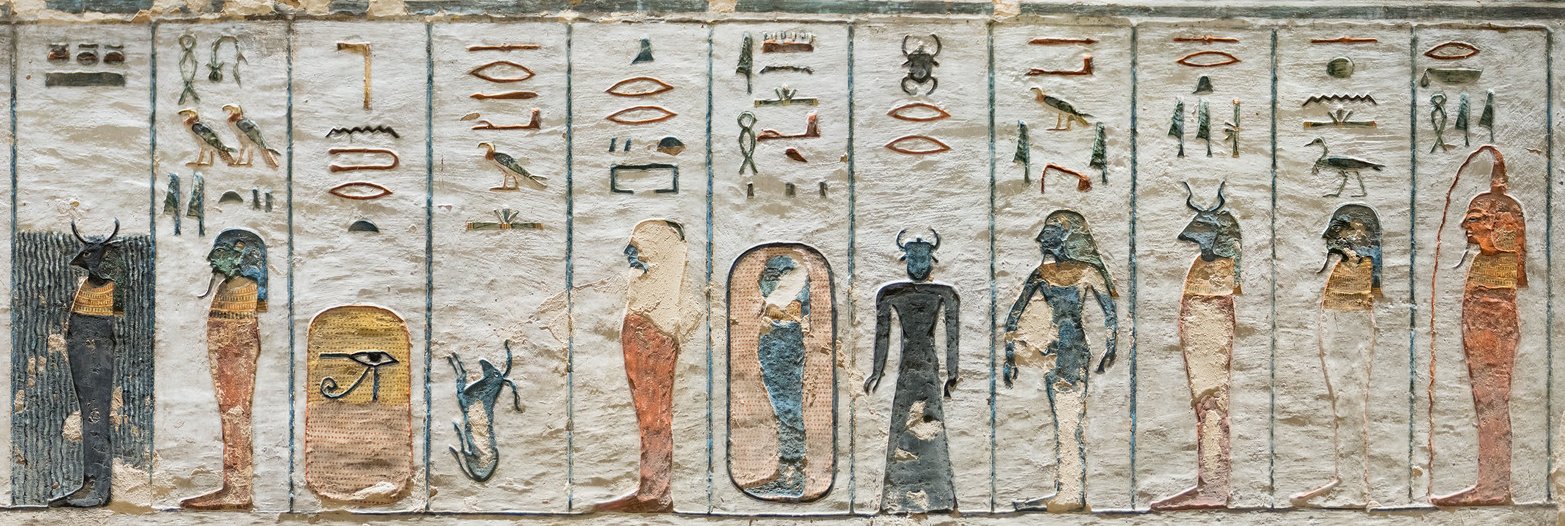
Forms of Re from the Great Litany in the tomb of Ramesses III (photograph courtesy of kairoinfo4u).
That union lies at the heart of Egyptian theology: Re, the sun, was the transformative power of creation; Osiris was the inert mummy who lay in the depths of the Netherworld. In the deep of the night, the "complete darkness," as the Egyptians termed it, the two deities merge: Re, the ba-soul element, united with Osiris, the corpse, and from that union, the cosmos is recreated and new life bursts forth. The Egyptians called Re-Osiris "the United One," and a famous scene from the tomb of Nefertari depicts the gods as a single entity, a ram-headed mummy crowned with a solar disk. Isis and Nephthys protect the god, while two hieroglyphic captions state the great secret of Egyptian theology: "It is Re who rests in Osiris. It is Osiris who rests in Re."
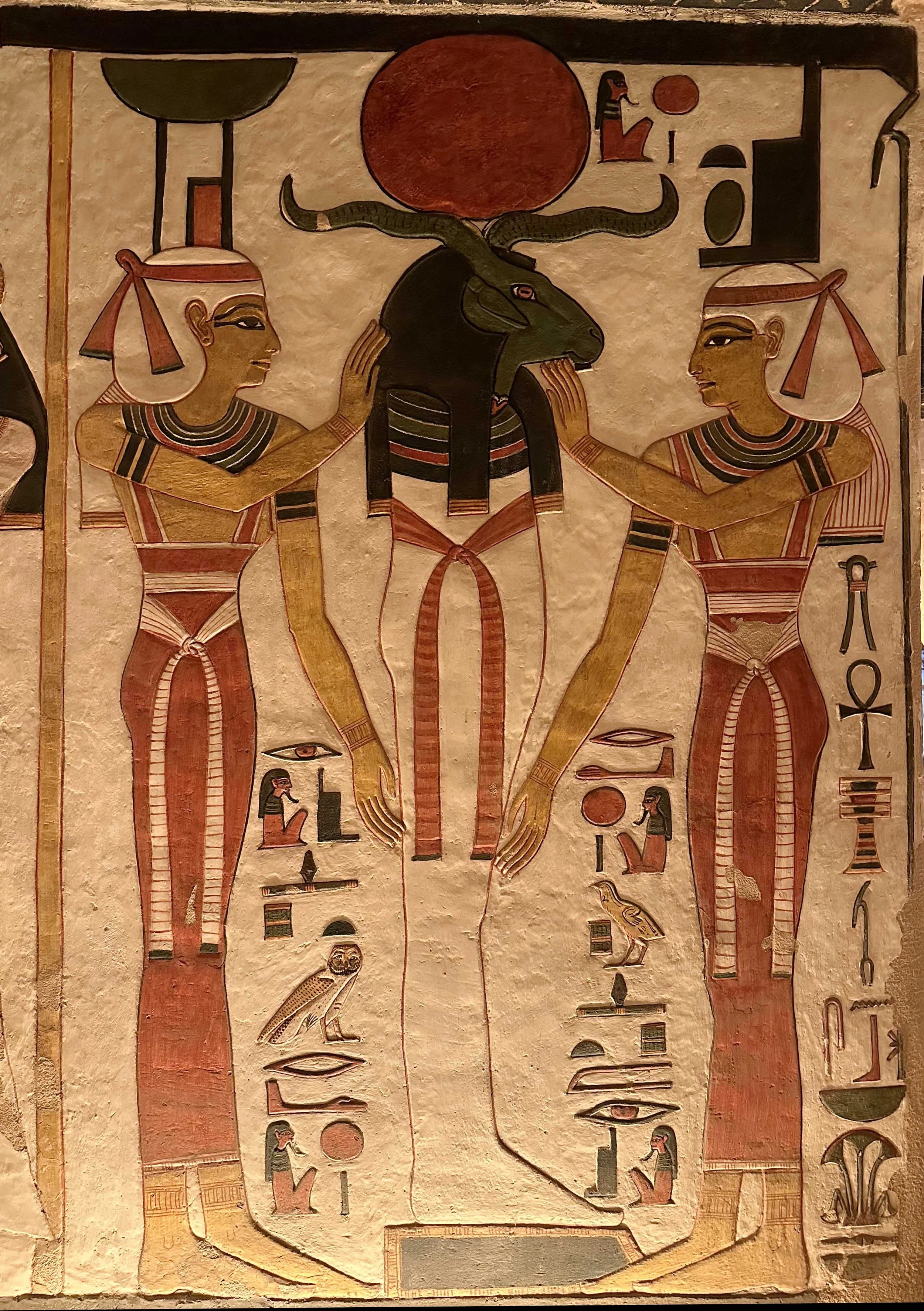
Painted relief in the tomb of Nefertari depicting the unified Re-Osiris (photograph by Colleen Darnell).
The "Book of Adoring Re in the West" focuses on the solar-Osirian unity, but like the Amduat, the text includes a title that describes its ritual use—the composition is not only to be read and studied, but also to be applied:
Beginning of the Book of Adoring Re in the West, adoring the United One in the West.
One recites this book,
while these images are executed in registers upon the wall,
in the deep of the night.
It means that Re triumphs over his enemies in the West.
It is effective for a man on earth;
it is effective for him after he moors.
The instruction to lay out the images “in registers” may refer not only to their orderly arrangement but also to the rectangular frames that enclose each figure of the Great Litany. Enclosing the image enclosed its power, just as in the Amduat Catalog, where the First Hour’s annotations about “knowing” the divine names are reinforced by setting each name and image within its own rectangle. The recitation and drawing of the images from the Book of the Hidden Chamber (the Amduat) and Book of Adoring Re in the West (Litany of Re) capture the power of the solar cycle and harness its limitless potential: not only does Re defeat his enemies thereby, the book is effective for a man, living, "on earth," or dead, "after he moors."
The Litany of Re begins with an image, first attested in the tomb of Seti I, that shows how appearances can deceive in the Netherworld. At the center is the sun disk, containing a scarab beetle and a ram-headed god—the diurnal and nocturnal forms of Re. Above the disk is a snake, below it a crocodile, and both face an antelope with a flame between its horns.
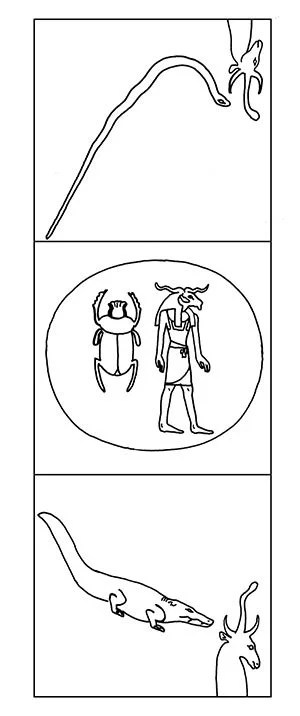
The antelope with flame appears as a protective image elsewhere in the Netherworld Books, but why would a dangerous crocodile and serpent appear next to the sun god? Royal tombs of the Nineteenth and Twentieth Dynasties give us their names, but only one source spells out their job: the sarcophagus lid of a woman named Tadipakakem, carved in the mid-fourth century BCE, nearly a thousand years after Seti I. On the lid, Tadipakakem kneels in prayer on either side of the sun disk, and the snake and crocodile nearly touch her knees. Their captions read:
Serpent of roasting flame who guards the portal of the West in the Netherworld.
Crocodile who guards the western portal in the Netherworld.
The snake and crocodile are gate guardians, just like the knife-wielding doorkeepers in the Book of the Dead. Throughout Egyptian history, snakes and crocodiles were among the most feared creatures for the living and the dead. Spells against them appear already in the Pyramid Texts, and centuries later, priests in Ptolemaic temples still ritually "slaughtered" crocodiles as enemies of the gods. Yet both serpents and crocodiles can also appear in positive and protective roles, such as here in the Litany of Re. These very creatures act on behalf of the sun god—and on behalf of the deceased who hopes to share in the sun's daily rebirth.
As in the Book of the Dead, the key to transforming a hostile power into a protective one is knowledge. In the Seventh Hour of the Amduat, a crocodile guards a sandbank, and from him the eye of Re emerges. On the sarcophagus of a man named Tjaihorpata, also from the fourth century BCE, this crocodile receives a caption that makes explicit the benefit of the knowledge:
The one who knows it is one whose ba-soul the crocodile will not swallow.
The crocodile in the Netherworld, who is upon the bank—
his things exist as protection for the Osiris Tjaihorpata.
On the cosmic level, the crocodile protects the sun god as he travels through the night. On the personal level, the very same crocodile protects the deceased, who knows him and his name.
The forms of Re in the Great Litany act as gate guardians, too. The New Kingdom versions of the text connect knowing their names with opening the doors of the Netherworld:
The Osiris [King] addresses them by their names;
the Osiris [King] calls them by their manifestations,
so that they might open the Netherworld for the Osiris [King],
so that they might throw open the portals of the secret place for his ba-soul.
Where the Litany appears on tomb walls reinforces this role. In the royal tombs, the Great Litany fills the first two corridors, the passage from the world of the living into the tomb's deeper portions, which form a model of the Netherworld. In the tomb of Ramesses IX, a few figures from the Great Litany surround a doorway deeper in the tomb. Outside the Valley of the Kings, the Litany appears in the subterranean corridor of the Edifice of Taharqa at Karnak.
The role of the seventy-five forms of the sun god as gatekeepers becomes even more explicit in the Late Period. One type of Late Period sarcophagus, which I termed "Type II" in my monograph The Late Egyptian Underworld, combines excerpts from four Netherworld Books—the Amduat, the Book of Gates, the Litany of Re, and the Book of the Night—into "units," each representing one hour of the night. For the first eleven hours, a unit consists of two or three addresses from the Great Litany, one of the gateways from the Book of Gates, and an hour from the Amduat. The forms of Re thus stand right beside the gates of the Netherworld, exactly like the gate-guarding demons of Book of the Dead chapters 147 and 148.
Tjaihorpata's sarcophagus, which we met above, preserves a version of the Litany's title that is found nowhere else. It shows us how the forms of Re were thought to help an individual:
Names of the gods who receive Re in the Netherworld.
May they receive the Osiris Tjaihorpata with their own arms!…
May they open for the Osiris Tjaihorpata the doors of the necropolis,
so that he might travel over their caverns,
so that he might enter the portals of the West…
May he enter into the West with Re in his boat,
so that he might adore the cavern-dwellers of the Netherworld,
so that he might rise with him in the eastern horizon like the lord of eternity.
The divine forms receive the deceased, open the portals for him, and send him on his way to join Re in the sun boat. And on the lower part of that same lid, Tjaihorpata included two rows of gate guardians from Book of the Dead chapters 147 and 148—the "classic" Egyptian demons—alongside excerpts from the Netherworld Books. To the Egyptians who designed his sarcophagus, the two groups of beings clearly belonged together.
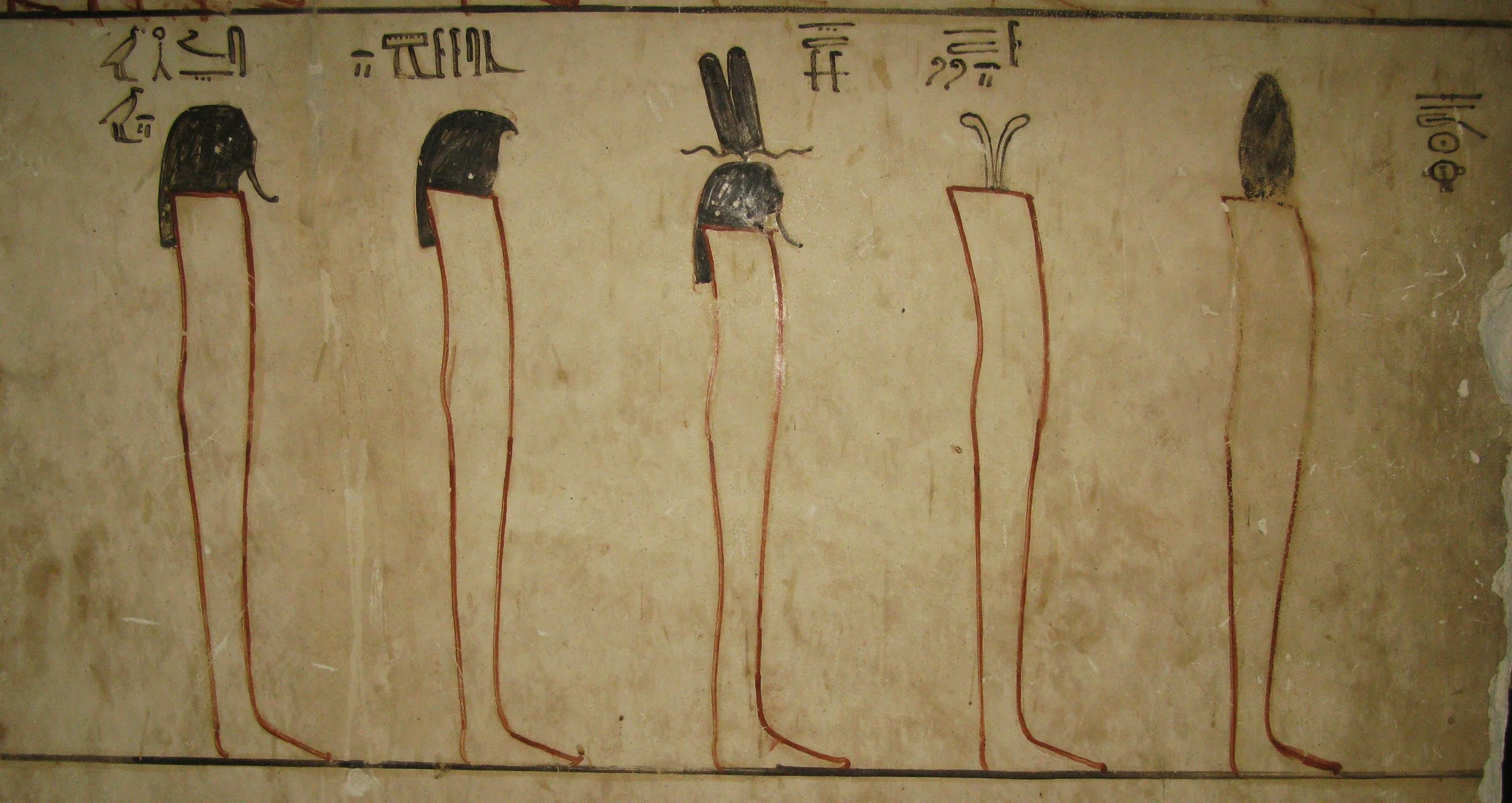
Forms of Re from the Great Litany in the burial chamber of the tomb of Thutmose III.
If we accept the gate guardians of the Book of the Dead as demons, then the seventy-five forms of Re in the Litany belong in any discussion of Egyptian demons as well. And they certainly look the part. The Great Litany contains some of the most "monstrous" figures in all of Egyptian religious art. Consider the form called "Binder" in the Sixty-Fourth Address: a mummy with coils of rope in place of a head. His hymn reads:
Praise to you, Re, high and mighty,
lord of bindings against his enemies,
great sole one, chief of the monkeys!
You are indeed the corpse of the Binder.
In a single bizarre image, "Binder" captures both the sun god's power to tie up and punish his enemies and the mummified corpse of that same god. Each of the seventy-five addresses in the Great Litany has the same structure: "Praise to you, Re, high and mighty," the name and a description of the form of Re, then the statement "You are indeed the corpse" of that form. The monstrous appearance of the "Binder" is not a departure from Egyptian religion, but like all of the solar forms in the Litany, it expresses the union of Re and Osiris. The "demonic" powers of the sun god are the result of that union—and as the Amduat tells us, knowing such beings is part of the cosmic knowledge that keeps the universe running. The seventy-five forms of Re are emanations of the creator: the god who, as Egyptian hymns put it, "made himself into millions" and sends out his many forms to protect himself, and through himself, the entire cosmos.
When we think of Egyptian demons, then, we should not imagine creatures standing outside the divine order. The beings of the Netherworld Books show that the line between "god" and "demon" was drawn according to function, location, and knowledge rather than by moral categories. A serpent bound to a desert road, a crocodile guarding a sandbank, a mummy with a head of rope—each was part of the vast, carefully catalogued population that kept the sun moving through the night. To understand Egyptian demons, we must read these texts. And to master the demons, as the Egyptians knew well, you must first learn their names.
Want to explore more of the ancient Egyptian supernatural? Join me for my live, remote class Ghosts of Ancient Egypt on Zoom, October 27 and November 3, where we will read the ghost story of Khonsuemheb and other texts in translation. Registration is at colleendarnell.com/classes.
Further Reading
Colleen Manassa, "Divine Taxonomy in the Underworld Books," Archiv fur Religionsgeschichte 14: 47-68 (from which this blog post is adapted).
Colleen Manassa, The Late Egyptian Underworld: Sarcophagi and Related Texts from the Nectanebid Period (Wiesbaden: Harrassowitz, 2007).
John Coleman Darnell and Colleen Manassa Darnell, The Ancient Egyptian Netherworld Books (Atlanta: SBL Press, 2018)