
In Part 1 we met a story that stops in the middle of a sentence: The Quarrel of Apepi and Seqenenre, a tale of a Hyksos king, a Theban king, and some very noisy hippopotami. Before turning to the text itself, it helps to know the cast and the stage. The two named characters are real kings, known from historical documents, royal and private monuments, king lists, and, in Seqenenre's case, a mummy. And the two cities in which they hold court, Avaris and Thebes, can still be visited and excavated today.
Apepi, ruler in the north
The kings Apepi and Seqenenre ruled at the same time, and Apepi's reign would outlast Seqenenre's own and continue through the reign of Seqenenre's successor Kamose and into the reign of Ahmose. From his capital at Avaris (ancient Hutwaret), Apepi controlled the Delta and the Nile Valley south to the region of Hermopolis and Cusae in Middle Egypt. Seqenenre ruled from the region of Thebes (ancient Waset) and held sway from the Middle Egyptian border with the Hyksos to Elephantine, at the First Cataract of the Nile.
Among the Hyksos pharaohs of the Fifteenth Dynasty, Apepi enjoyed the longest rule, probably around forty years. Although Apepi himself did not use the title heqa-khasut, "ruler of the foreign lands," at least one Egyptian text refers to him as "sovereign (wr) of Retjenu," one of the Egyptian names for the southern Levant. That title probably reflected the reality of his origins as well as the southern Egyptian opinion about his unsuitability for the office of pharaoh.
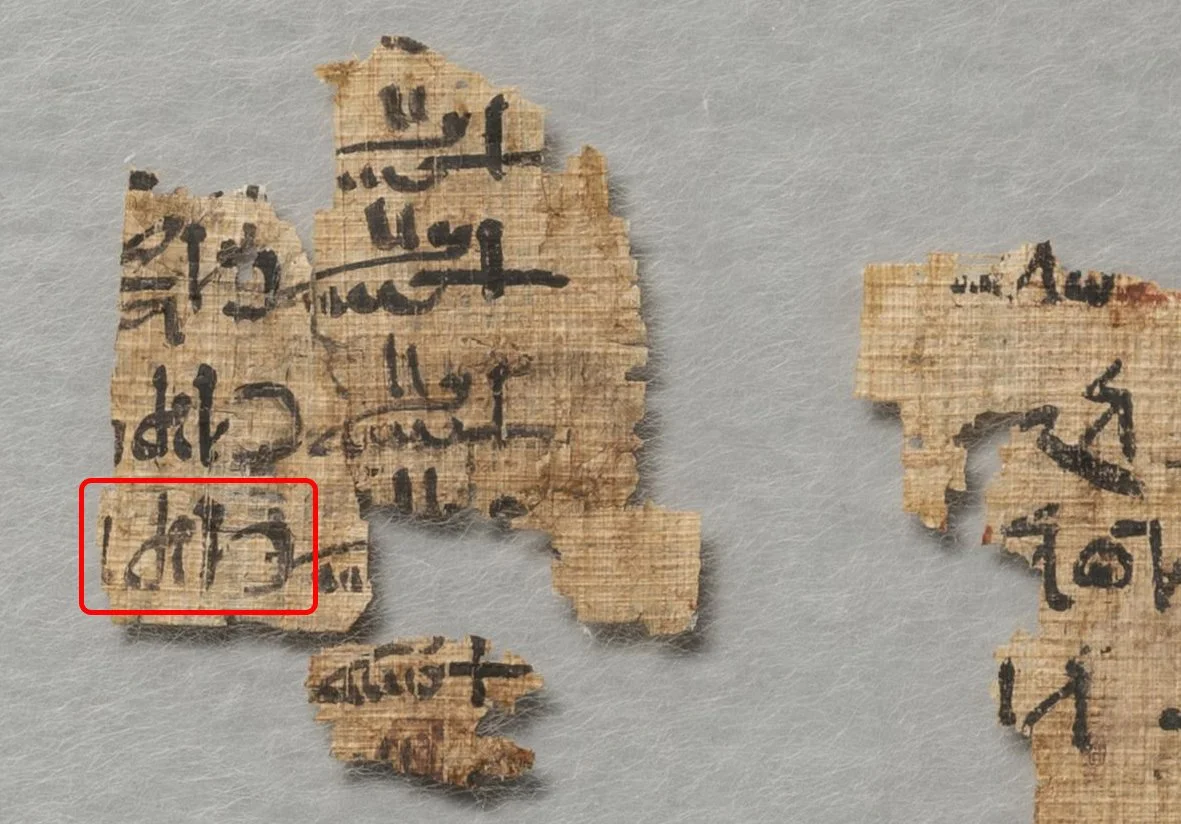
Fragments from Column 10 of the Turin Kings List/Royal Canon (Egyptian Museum, Turin, Cat. 1874 [public domain]). The red box indicates the beginning of the name Apepi.
We lack lengthy historical texts written from the Hyksos point of view. Instead, small scarab seals, scattered monuments, and above all the archaeological record at Avaris provide the bulk of the information about the identity of these foreign rulers. Apepi ruled over a mixed population of Egyptians and people from the southern Levant, the latter partially Egyptianized. The "ethnicity," or more likely multiple ethnicities, of the Hyksos rulers and their foreign subjects remains a topic of debate. Even the names of the Hyksos kings, complicated by incomplete overlap between hieroglyphic sources and later Greek and Roman accounts, remain a tenuous guide to their origins.
The last two decades of Apepi's rule saw his authority threatened by the rising power of Thebes. Apepi's capital was attacked during the reign of Kamose, and the Hyksos dynasty was finally driven from Egypt during Ahmose's reign. That event marked the reunification of Upper and Lower Egypt under a single Egyptian pharaoh and the beginning of the New Kingdom, around 1550 BCE. The expulsion of the Hyksos did not merely reunify the country; it appears to have embodied a new imperialist spirit in Egyptian foreign relations, one that would carry Egyptian armies deep into the Near East.
Seqenenre, king of "this part" of Egypt
As a pharaoh who ruled only the southern portion of the Nile Valley, Seqenenre held a precarious kingship, a balance of traditional political ideology and contemporary realities. No surviving historical texts from his reign explain how he legitimized his rule or how he dealt with the unusual circumstances of his kingship, or indeed those of the entire Seventeenth Dynasty.
The lengthy stelae of his successor Kamose, however, offer a window into the mind of a Theban apologist, forced to reconcile his pharaoh's difficult position as king of only "this part" of Egypt with traditional royal ideology. The opening of the First Stela, as preserved on the Carnarvon Tablet, speaks of Kamose's kingship in terms that parallel the beginning of our story:
The victorious king within Thebes, Kamose, given life forever, was a beneficent king. It is Re who placed him as veritable king, and who truly granted victory to him.
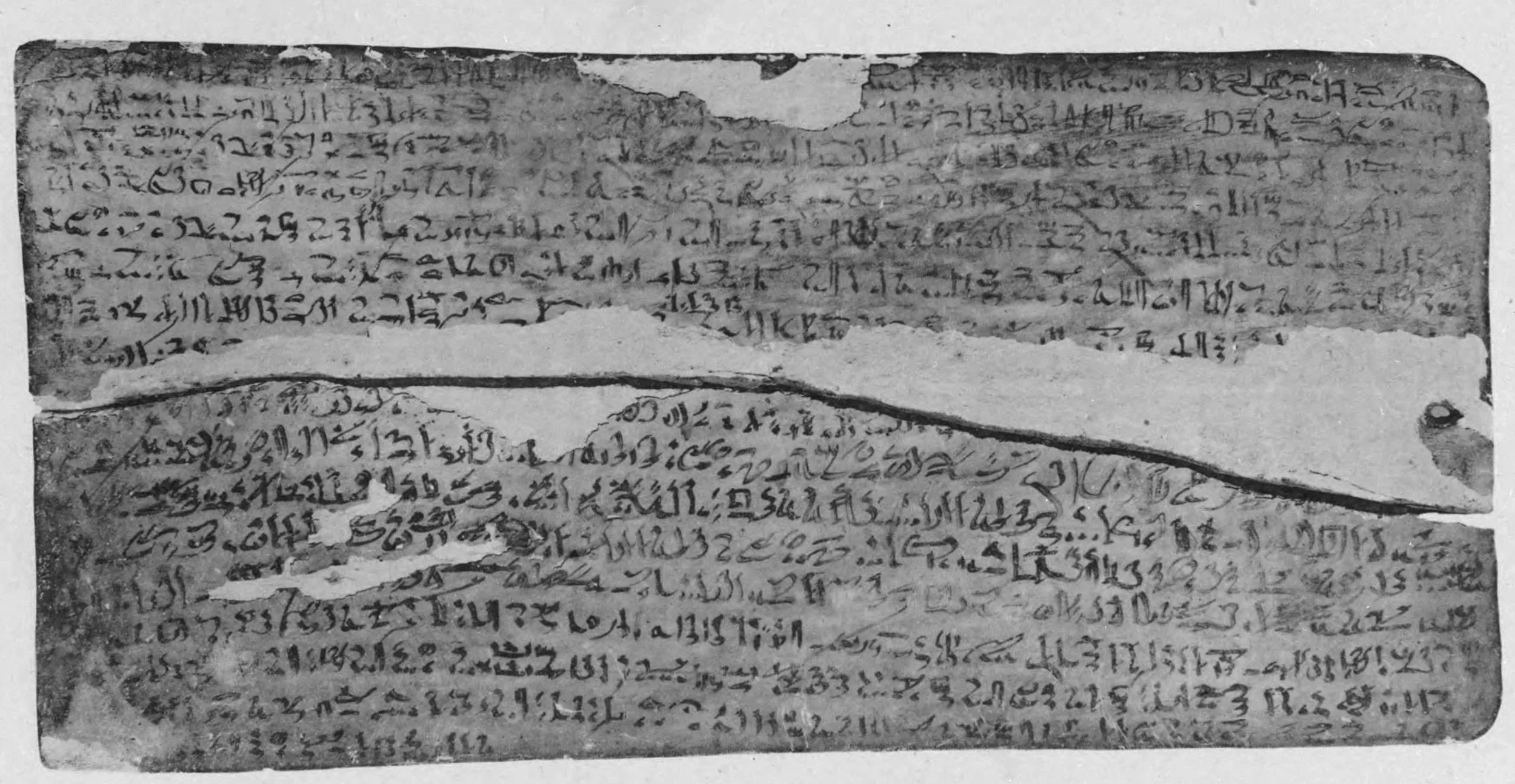
Carnarvon Tablet I, a hieratic copy of the First Kamose Stela (Public Domain, Earl of Carnarvon and Howard Carter, Five years' explorations at Thebes : a record of work done 1907-1911 (1912), p. 155).
Such statements of divine legitimacy appear in other royal texts, but in Kamose's stela, the institution of kingship itself receives heightened emphasis. Kamose is victorious, beneficent, and above all veritable: a true king. These terms provide an interesting contrast to the mention of the sovereign in Avaris a few lines later on the Carnarvon Tablet:
How should I understand my power, with a sovereign (wr) in Avaris and another in Kush?
Kush was the powerful Nubian kingdom to the south, centered at Kerma in what is now Sudan, the third power player in the Second Intermediate Period. The difficult passage at the start of the Second Stela of Kamose specifically contrasts the rank of the Theban king with that of the foreigner Apepi:
Your speech is wrong (literally "narrow"), when you make me as a sovereign (wr), while you are ruler (heqa) ...
A game of titles
In a historical inscription, then, Kamose could characterize Apepi as a mere "sovereign" (wr) while the Egyptian leader was a proper king, despite Apepi's claims to the contrary. The same situation holds in the introduction of The Quarrel of Apepi and Seqenenre: Seqenenre is a "king" while Apepi is a "sovereign." Following the short introduction, however, the story consistently uses entirely different titles: Seqenenre becomes "sovereign of the southern city," and Apepi becomes "king." This switch serves a dual purpose.
First, the introduction of the story reflects the political message of Seventeenth Dynasty Theban texts, which were among the historical sources the Ramesside author could have consulted when composing the tale. ("Ramesside" refers to the Nineteenth and Twentieth Dynasties, many of whose kings were named Ramesses.) The terms "king" (nesut) and "sovereign" (wr) create the same distinction in political roles that concerned the authors of the Kamose stelae. Apepi's monuments do not use the title heqa-khasut, "ruler of the foreign lands"; only the first three kings of the Fifteenth Dynasty—Semqen, Aper-Anati, and Seker-Her—use that title in their titulary.
Second, the change in titles between the introduction and the main narrative forces the reader to reconsider who rightfully holds which office. An Egyptian audience would expect the Egyptian-born Seqenenre to be the proper possessor of the title "king" at the beginning of the tale, and the jarring change to the foreign "king" Apepi highlights the inappropriate nature of the latter's actions. The story appears to suggest that Apepi does not deserve the title "king," whereas Seqenenre acts according to maat, the Egyptian concept of truth, justice, and cosmic order. Despite his lesser position as "sovereign of the southern city," Seqenenre is the actual, divinely appointed king.
The royal ka
The story does not directly mention the royal ka, but this concept may explain Seqenenre's shifting status most clearly. The ka-spirit was a person's double and the soul that interacted most with the social realm, needing to be re-integrated with the deceased's family and friends after the disruption of death. The royal ka was the inherited spirit of kingship, passed from generation to generation of pharaohs by the god Amun-Re, who was believed to father the future king with the chosen queen.
Even if a pharaoh was not of the expected gender (Hatshepsut, for example) or not of royal parentage (Horemhab), he or she possessed the royal ka from conception, when the creator god Khnum fashioned both the earthly body and the royal spirit upon his potter's wheel. Historical parallels thus exist for Seqenenre's double status. The introduction to the tale acknowledges that Seqenenre possesses the royal ka, while the rest of the narrative recognizes that his authority was limited to Upper Egypt, making him in practical terms "sovereign of the southern city."
The surviving monuments of Seqenenre's reign come from overtly religious or funerary settings, places where his identity as inheritor of the royal ka entirely overshadows the unfortunate realities of his reign. One should not expect the title "sovereign of the southern city" to appear in documents from Seventeenth Dynasty Thebes.
What's in a name?
An additional and previously overlooked aspect of the story is the choice of royal names. Egyptian kings had five names; the two most important, each written inside a cartouche (the oval ring that encloses a royal name), were the nomen, or birth name, and the prenomen, or throne name, adopted at coronation. "Apepi" is a nomen, the Hyksos king's birth name. "Seqenenre" is a prenomen, meaning "the one whom Re has made mighty."
Why would the author choose different types of names for the two kings? The answer probably lies in the theology of the tale. The story characterizes Apepi as a worshipper of Seth, a king who acts so offensively that he offers Seth rituals appropriate for the sun god Re-Horakhty at Heliopolis. Yet all three of Apepi's known throne names refer to the god Re: Aaqenenre, "the might of Re is great"; Aauserre, "the power of Re is great"; and Nebkhepeshre, "lord of the khepesh-sword of Re." To use any of these throne names would undermine a driving element of the plot.
Similarly, Seqenenre's birth name is Taa, written like the word ta "bread," but more accurately read as Djehuty-aa, "Thoth is great." The author seems to have alternated types of royal names quite intentionally. One of Apepi's throne names, Aaqenenre, differs from Seqenenre only in its first element, and both names proclaim the might of the sun god Re. Naming, as well as namelessness, carries profound meaning in Egyptian literature, and The Quarrel of Apepi and Seqenenre belongs to that same literary tradition.
How later Egyptians remembered the two kings
The Ramesside royal family came from the Delta, and their capital, Piramesses, sat right beside Avaris. Those northern ties may have encouraged interest in the Hyksos dynasty, and on one level the story can be read as a defense of the cult of Seth, a god favored by the foreign rulers but also by the Ramesside kings (more on that to come). Yet nothing within the tale or in any other Ramesside text suggests that the foreign Apepi, rather than the Egyptian Seqenenre, is the hero. Ramesside sources do not commemorate Apepi or any other Hyksos ruler positively, although king lists such as the Turin Canon acknowledged the reality of their rule.
Seqenenre, on the other hand, does appear in Ramesside sources, as one would expect of a Theban king from the same family as Amenhotep I and Ahmose Nefertari, who were venerated as local royal "saints" at Thebes. A dedicated antiquarian such as Prince Khaemwaset, the son of Ramesses II famous for restoring ancient monuments, could have visited Seqenenre's tomb at Dra Abu el-Naga. That pyramid-topped tomb appears in the list of monuments inspected during the tomb robbery investigations under Ramesses IX, and the papyrus record (Papyrus Abbott) notes that it was still intact. Seqenenre's cartouche appears on an offering table of the scribe Kenherkhopeshef, and Seqenenre is depicted in two tombs at Deir el-Medina, the village of the royal tomb builders.
The scribes: the story's third character
The memories of Apepi and Seqenenre were preserved, for Ramesside Egyptians as well as for modern readers, primarily by scribes: the men who copied king lists, composed historical inscriptions, and laid out the hieroglyphic texts on royal and private monuments. Scribes are at the heart of the surviving portion of the story, whether in the court of the foreign king or the Egyptian pharaoh.
Scribal "propaganda" promoting the profession itself is everywhere in New Kingdom teaching texts. The injunction "Be a scribe!" was reinforced by an entire genre of texts, and the preeminence of the written word extended even to the afterlife: in one famous passage (Papyrus Chester Beatty IV), books are said to preserve a man's name better than a pyramid.
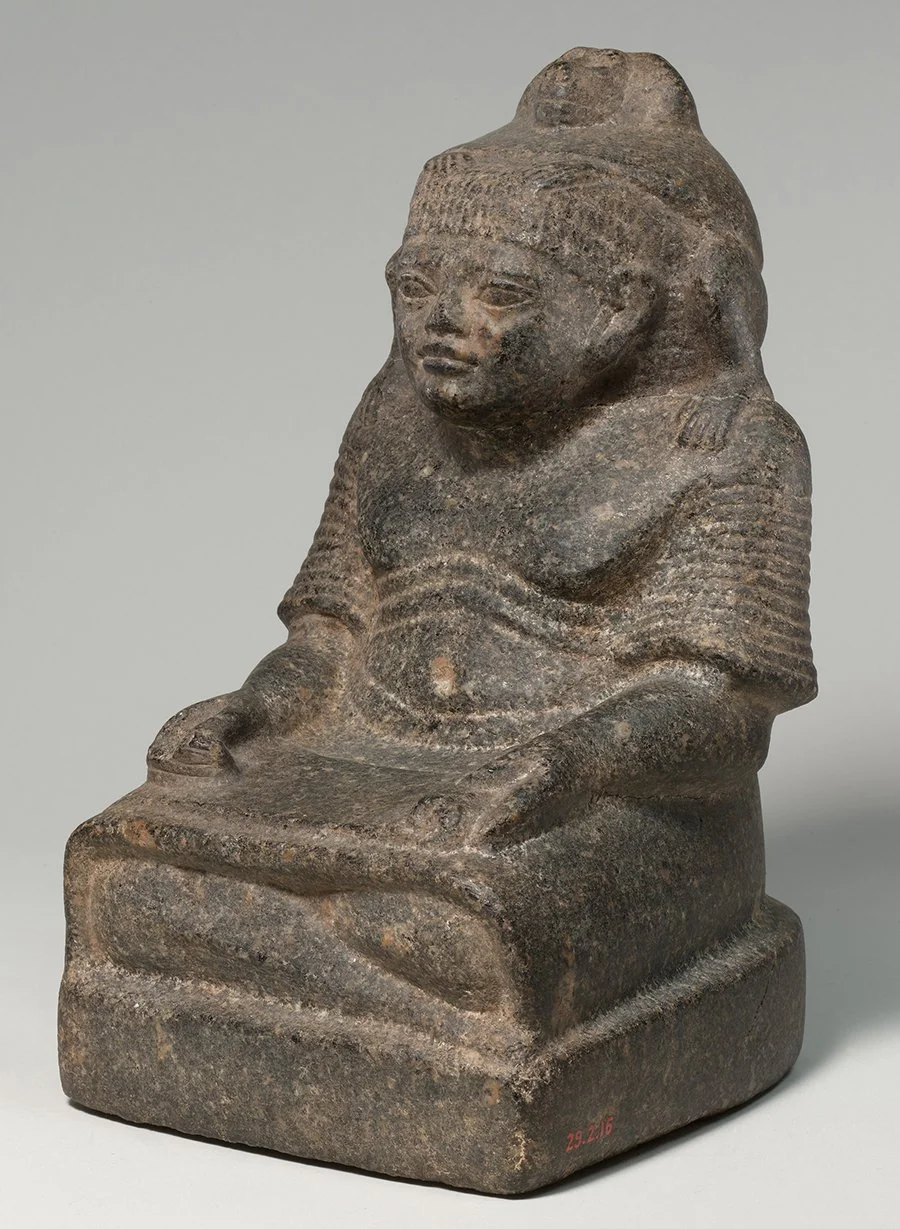
Statue of an ancient Egyptian scribe with a baboon, an avatar of the god Thoth, perched on his head, Ramesside Period, ca. 1300-1080 BCE (Public Domain). Metropolitan Museum of Art 29.2.16.
A Ramesside scribe with access to documents such as the Kamose stelae would have found confirmation that Egyptian was the common language of diplomacy in Second Intermediate Period Egypt. The Second Stela reproduces the text of a letter sent from the Hyksos king in Avaris to the ruler of Kush at Kerma, intercepted when Kamose's troops captured its messenger on a Western Desert oasis road. Only Egyptian could have enabled the Hyksos and Kushite kings to communicate with one another or with their Theban rival. Egyptian scribes in all three political centers made the exchange of messages possible. Through the fictional narrative of The Quarrel of Apepi and Seqenenre, Ramesside scribes were reminded of their centrality in Egyptian society, as well as their role in the making of history.
Two captials
In Egyptian political theology, the unification of Upper and Lower Egypt under a single pharaoh went hand in hand with the creation of a national capital. Memphis, at the apex of the Delta, bore the symbolic name "Balance of the Two Lands." New Kingdom literature even includes poems in "praise of cities," expressions of admiration and longing for an urban center that find some of their closest parallels in love poetry. Our story likewise situates each king in his capital city. A specific time and an accurate historical place: these two elements define historical fiction, in ancient Egypt as in modern bookstores.
The Hyksos capital was Hutwaret, Greek Avaris, modern Tell el-Dab’a, on the Pelusiac branch of the Nile in the eastern Delta. Its original name, Ra-waty, means "beginning of the two roads," and under Hyksos patronage the old crossroads became a boom-town. By the late Twelfth Dynasty (around 1800 BCE), a foreign population had already settled at Avaris, with house types originating in the northern Levant and imported pottery linked to the southern Levant. Simply stated, the first substantial Asiatic population of Avaris came from more than one place. ("Asiatic" is the Egyptological translation of the Egyptian terms for people from western Asia.) These foreigners served the Egyptian state as soldiers, traders, and expedition members, and later held office in the administration of the Thirteenth Dynasty.
Instability and a plague contributed to a collapse at Avaris around 1730 BCE, followed by the rise of a local northeast Delta dynasty, the Fourteenth. The Hyksos Fifteenth Dynasty likewise did not arise from a single homogeneous group; its century-long rule depended on complex interactions among the foreign kings, Egyptian officials, and a diverse foreign population with particularly strong links to the northern Levant.
The story itself focuses only on Apepi's palace and the temple of Seth. If the author had a real building complex in mind, the best candidate is the "citadel" area of Avaris known today as Ezbet Helmi, excavated by the Austrian Archaeological Institute in Cairo. There, a late Fifteenth Dynasty palace-fortress had a rampart with projecting towers, gardens, and a water system. About five hundred meters away lay a temple of Seth, though its Hyksos-period phase has not yet been found. After Ahmose's conquest, the palace was converted for Egyptian use; later, Eighteenth Dynasty palaces were decorated with Minoan-style paintings of bull-leapers and griffins, and Tutankhamun and Horemhab renovated the temple of Seth. By the reign of Ramesses II, the area had been transformed into the new capital city of Piramesses, a cosmopolitan port, arsenal, and home to royal stables. A Ramesside scribe praised it this way (Papyrus Anastasi III):
The (city) beautiful of windows (for royal appearance), shining of halls of lapis lazuli and turquoise. The place of giving commands to your chariotry; the place of marshalling your army; the place of mooring your naval troops.
Thebes, the largest city in Upper Egypt, owed its wealth in part to desert highways connecting it with the Red Sea, the mines of the Eastern Desert, and the caravan routes of the Western Desert. When the story was composed, Thebes was dominated by the vast temples of Karnak and Luxor on the east bank and the royal temples and tombs of the west bank, all integrated into a massive "estate of Amun." The story perfectly captures this feature of the "southern city" in Seqenenre's devotion to Amun-Re, and two stelae from Karnak show Seqenenre worshipping that god.
Ironically, the impressive standing monuments of Thebes conceal how little survives of its houses and palaces. Seqenenre's palace has not been found. The closest parallel is Deir el-Ballas, about 45 kilometers north of Thebes, where two large palaces were excavated, built with the same kind of mud-brick platforms as the Hyksos palace at Avaris. A lintel of Seqenenre and abundant pottery show that the Seventeenth Dynasty kings kept a presence at this strategic spot, close to Thebes but protected by desert cliffs. Was the author of the story aware of Deir el-Ballas, or did he choose Thebes for its theological significance as the home of Amun? The answer must await new evidence.
With our cast and stage in place, Part 3 turns to the text itself: a land in the grip of pestilence, a king devoted to Seth, and a letter in the making. Apepi and Seqenenre’s dueling claims to Egyptian kingship, the economic and geographic advantages of Avaris and Thebes, and more are main themes in my live class FIRE AND SWORD ON THE NILE, on war in the Second Intermediate Period and early New Kingdom (live on Zoom, November 17, December 1, and December 8 from 2-3:30 and 8-9:30 PM US Eastern Time).