
Part 1 — A Story That Stops Mid-Sentence: The Quarrel of Apepi and Seqenenre
In 1203 BCE, as the scribe Pentaweret dipped his rush pen in red ink to copy the first words of the story now known as The Quarrel of Apepi and Seqenenre, approximately three hundred and forty years separated the Egyptian treasury official from the events described in the tale he was reproducing. Five years earlier, the armies of the pharaoh Merneptah (thirteenth son and successor of Ramesses II) had defeated a combined invasion by the Libyans and their Sea Peoples allies, and Pentaweret lived during a time of prosperity in the Nile Valley. But the story he was copying was set in a far more turbulent period of Egyptian history.
The Quarrel of Apepi and Seqenenre begins with a specific time and place: Egypt during the tribulations of foreign rule. Between 1650 and 1550 BCE, the Nile Valley from its Delta shores to southern Middle Egypt was under the control of a dynasty of foreign kings, the Hyksos. The name "Hyksos" is a Greek rendering of the ancient Egyptian heqa-khasut, "Ruler of the Foreign Lands." Egyptologists call this era the Second Intermediate Period, one of the stretches of time when Egypt was not unified under a single king.
The story opens with a dramatic summary of this complex period in Egyptian history. Without a single Egyptian pharaoh as ruler of the Two Lands (the Egyptians' own name for their country, joining Upper Egypt in the south with Lower Egypt in the north), pestilence—metaphorical and/or physical—runs rampant throughout the land. For the ancient Egyptians, a divided kingship was not merely a political inconvenience; according to their political theology, it was a state of chaos.
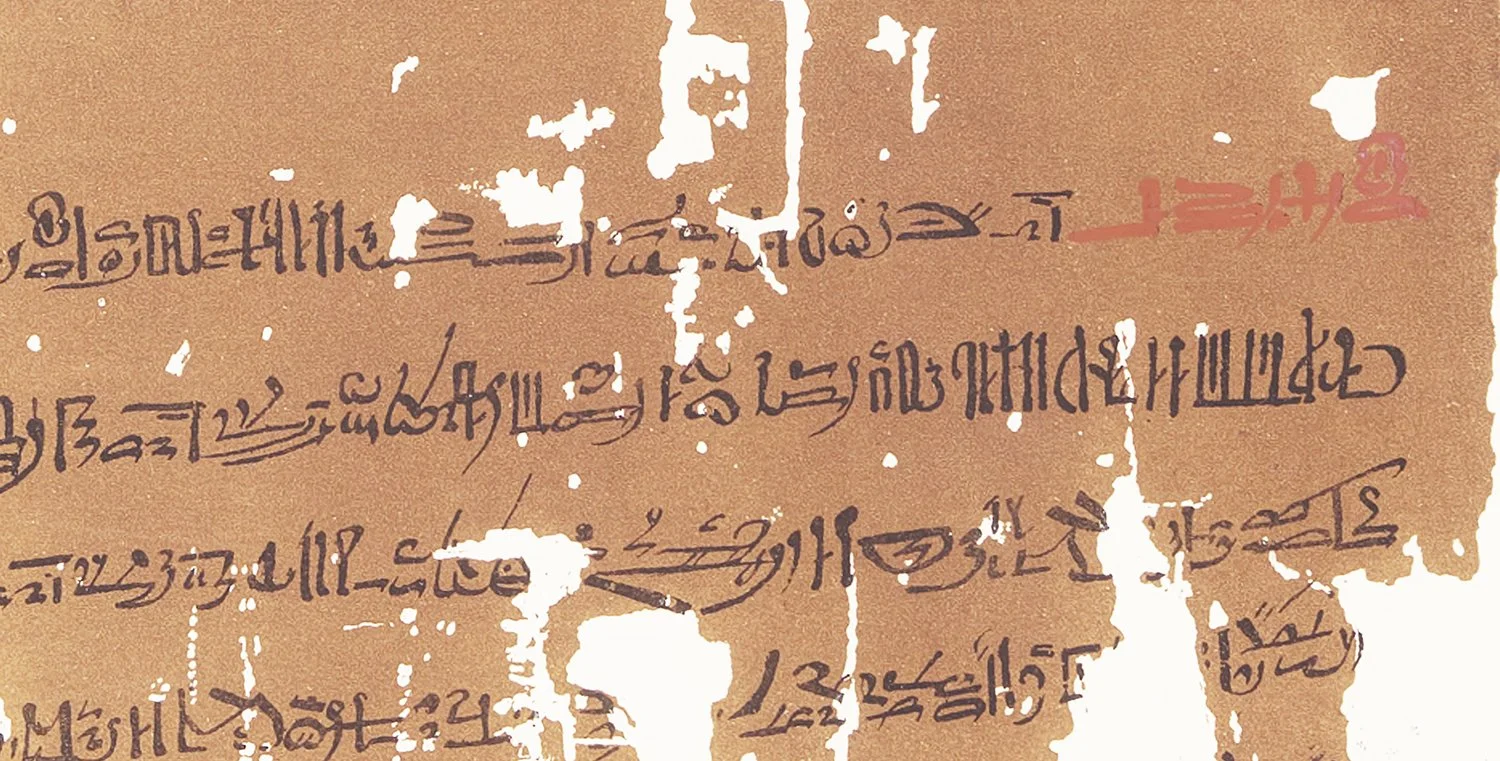
Facsimile of the first column of Papyrus Sallier I (British Museum EA 10185). Note the rubric (red ink) of the first line that is the introduction to the text, "It happened that." S. Birch, E. Hawkins, and J. Netherclift, Select papyri in the hieratic character, from the collections of the British Museum (1841), pl. 1.
The story in brief
The main characters of The Quarrel of Apepi and Seqenenre are two historically well-attested pharaohs. Aauserre Apepi was one of the last kings of the Hyksos Fifteenth Dynasty, ruling from the city of Avaris in the eastern Nile Delta. Seqenenre Djehuty-aa was the penultimate pharaoh of the Theban Seventeenth Dynasty, ruling from Thebes (modern Luxor) in the south.
The story introduces the Hyksos king as he calls together his scribes and dictates a message addressed to the Theban ruler Seqenenre. Once the Hyksos messenger arrives in Thebes, he repeats the content of Apepi's missive. The Hyksos king demands that Seqenenre take action against hippopotami east of Thebes, because their noisiness is keeping Apepi awake. Within the preserved portions of the story, this request lacks any context or explanation, compelling the modern reader to look for parallels in other sources. Five hundred and seventy kilometers (about 350 miles) separate Avaris from Thebes as the crow flies, making Apepi's request ridiculous to ancient and modern audiences alike.
The absurdity of the message leaves Seqenenre speechless, and he is unable immediately to respond to the Hyksos messenger. After a long pause, Seqenenre asks the messenger a question. Although the full content of the question is not preserved, the Theban king may use grammar that signals a sarcastic or mocking response. Seqenenre then consults his council, repeating to them Apepi's bizarre request.
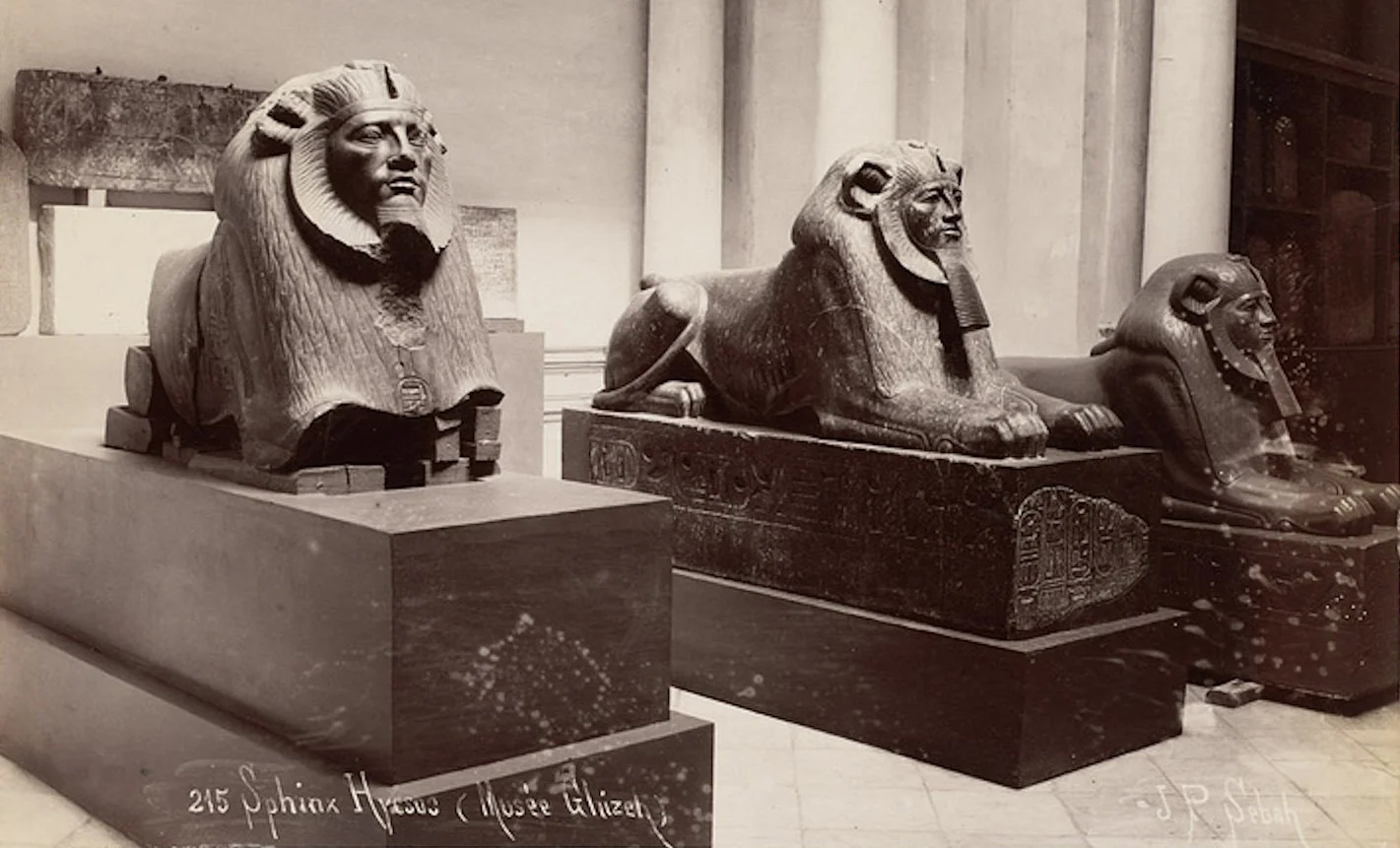
Sphinxes of Amenemhat III re-inscribed for the Hyksos king Apepi. Archival photograph of display in the Museum of Egyptian Antiquities; the sphinxes are now in the Grand Egyptian Museum.
The next event in the narrative will remain unknown until another copy of The Quarrel of Apepi and Seqenenre is discovered. The scribe Pentaweret stopped copying at this point in the story, literally in the middle of a sentence, and began to write out a "manual of letter writing." Pentaweret's motives for combining these two texts in such an unusual fashion may in fact be found in the content of the story itself, a question we will return to at the end of this series.
Like Troy: a story you can excavate
The Quarrel of Apepi and Seqenenre did not exist in isolation. It belonged to a rich web of other ancient texts, some of which still survive, and details within the narrative can be tested against intensive excavations at the very sites the story mentions. Like ancient Troy, Avaris and Thebes exist as archaeological sites as well as literary settings.
Few lengthy inscriptions survive from the Hyksos-controlled north or from its capital, Avaris (ancient Hut-waret; modern Tell el- Dab’a). Yet archaeological investigations at Avaris enable the modern reader to recover details about the physical layout of the city and the social identity of its inhabitants, details that can be compared with the portrait of Apepi in the story. Pentaweret’s contemporaries may have known the site better than we might assume. The political capital of Egypt during the Nineteenth Dynasty, when Pentaweret lived, was Piramesses, located just to the north of the site of Avaris. The ruins of the old Hyksos capital were, quite literally, in the Ramesside backyard.
In contrast, Seqenenre's Thebes (ancient Waset; modern Luxor) is archaeologically much less well known. On the east bank of the Nile, material from his era is limited to scattered remains beneath the later sprawl of Karnak Temple. Yet Karnak Temple was also the find-spot for one of the most significant historical records of the Second Intermediate Period: the Second Stela of Kamose. Kamose was Seqenenre's successor, and his stela, the second of an original pair, provides the most detailed source for his campaign against Avaris, including battles in northern Middle Egypt and a naval battle outside the Hyksos capital. Discovery of fragments of a third stela, and a historical text at Armant, have further expanded the primary sources of Kamose's reign.
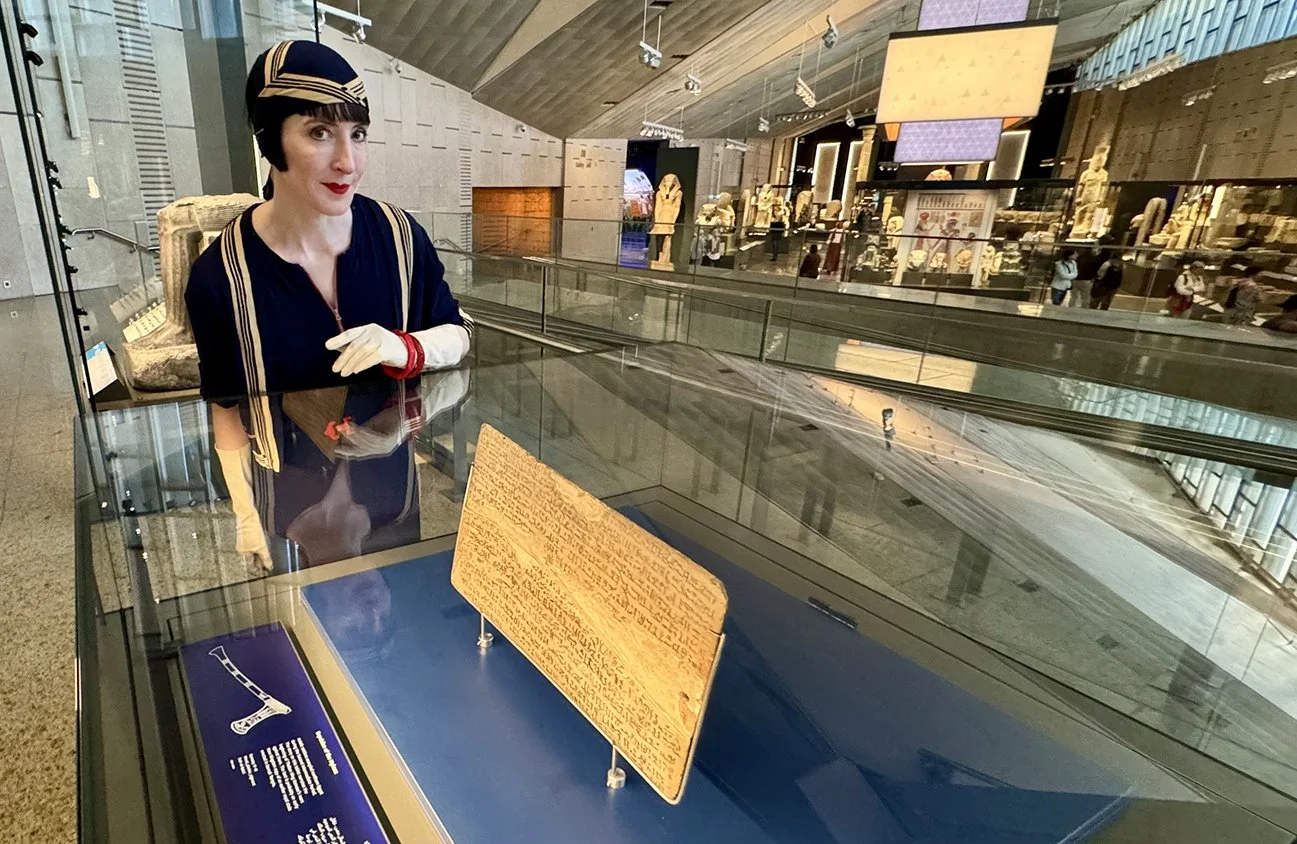
The First Stela of Kamose survives in a fragmentary copy from Karnak, as well as an excerpt copied in hieratic (the cursive, handwritten form of Egyptian script) on a writing board discovered in a tomb courtyard on the west bank of Thebes. Called the Carnarvon Tablet after the financier of the excavations, Lord Carnarvon, later of Tutankhamun fame, this writing board not only preserves key historical details from Kamose's reign, but suggests that the historical text was "published," or at least accessible, beyond the hieroglyphic stelae themselves. In other words, people were copying and reading royal history on portable writing surfaces, exactly the sort of material a later author might consult.
The body of a character
From the Theban west bank comes another quintessential Egyptian object with a direct bearing on the interpretation of the story: the mummy of Seqenenre himself. Around 935 BCE, the mummy was reburied in a cache of royal mummies, apparently as part of a state-sanctioned dismantling of the royal tombs. The cache lay hidden until 1881, when it was rediscovered as part of a dramatic tale of tomb robbery and hasty clearance. Remarkably, this discovery means that the body of one of the two characters within The Quarrel of Apepi and Seqenenre is available for modern study. Few works of fiction, ancient or modern, can make such a claim.
Early examinations of the mummy suggested that Seqenenre died in bed at the hands of an assassin, but more recent investigations indicate that he died from wounds sustained in battle. From the position and size of the wounds, the first blow may have been struck while Seqenenre was standing in a chariot. Two of the prominent wounds are small rectangular holes in the skull. The size of these wounds matches long, thin-bladed axes found in warriors' burials at Avaris dating to the late Fifteenth Dynasty, a type of weapon not attested in the Egyptian arsenal of the time.
The physical evidence makes it likely that the pharaoh Seqenenre died in battle against a Hyksos army. No surviving texts from his own time record the end of Seqenenre's rule, nor is his violent death mentioned in later sources, so Seqenenre's mummy functions as a unique historical record.
One papyrus, three texts
The fragmentary tale survives in only a single papyrus, British Museum EA 10185, better known as Papyrus Sallier I. It is dated to the tenth regnal year of Merneptah. A papyrus roll has two sides: the recto, where the papyrus strips run horizontally and which scribes usually wrote on first, and the verso, the back, where the strips run vertically. In addition to The Quarrel of Apepi and Seqenenre, the recto of Papyrus Sallier I also contains a letter-writing manual, and the verso holds a copy of the Instruction of Amenemhat I, a famous "wisdom" text in which a murdered king advises his son from beyond the grave.
The same Pentaweret who copied our story and the letter-writing manual was also responsible for a copy of the "Kadesh Battle Poem" in another papyrus, Papyrus Sallier III. That poem celebrates Ramesses II's famous battle against the Hittites at Kadesh in Syria in 1274 BCE. Although their original findspots are not recorded, Papyrus Sallier I and Papyrus Sallier III were probably part of a set of papyri from a single tomb at Saqqara, the great cemetery of Memphis. If this assumed origin is accurate and the group represents a "library," then The Quarrel of Apepi and Seqenenre sat alongside such Middle Kingdom classics as the Teaching of Khety, two copies of the Instruction of Amenemhat I (including one on Papyrus Sallier I), and the Hymn to Hapi (the god of the Nile flood), as well as the lengthy New Kingdom Tale of the Two Brothers and the popular Satirical Letter of Hori. A reader of this library could move from real royal history to imagined royal history with the unrolling of a papyrus.
On the papyrus, The Quarrel of Apepi and Seqenenre fills the first three columns of the recto, ending mid-sentence at the left margin of the third line of the third column. In the very next line, the scribe wrote the title of the following composition: "Beginning of the instruction of letter writing." The letter-writing manual contains eleven communications between the scribe Pentaweret and his superior, Ameneminet, chief of the record-keepers of the treasury. These letters were apparently chosen for their teaching value, as the use of "instruction" in the title suggests.
Far from being unrelated to the letter-writing manual, The Quarrel of Apepi and Seqenenre appears to provide an entertaining and instructive beginning to it, specifically chosen by the scribe to introduce the more sober contents of the papyrus. Although the significance of this pairing has been overlooked, it offers unique information about who read historical fiction in ancient Egypt and the many purposes it might serve for them.
How scholars have read the tale
Translated multiple times and included in standard handbooks of Egyptian literature, The Quarrel of Apepi and Seqenenre has been interpreted in widely divergent ways. Some have proposed a strictly "historicist" reading, one that treats the story as a straightforward record of real events. A major thread of analysis, first presented by the Egyptologist Jan Assmann, filters the characters and events through the lens of "cultural memory," the way a society remembers and reshapes its past. This approach essentially argues that the narrative blends two traumatic episodes into one: Hyksos rule and the reign of Akhenaten (1352–1336 BCE), whose focus on his own divine status and worship of Aten destabilized Egypt. A third set of interpretations has analyzed the story in terms of the "royal novel," an Egyptological term for a royal inscription that presents a historical narrative as a specific sequence of events emphasizing the king as hero. Some see the tale as a serious use of that form, others as a mockery of it.
Scholars have also given limited attention to particular puzzles: the shifting titles of Apepi and Seqenenre, and the significance of those hippopotami. Recent interpretations have examined the story with modern theoretical tools, and two of these prove especially useful for ancient Egyptian historical fiction: genre theory, and "intertextuality," the study of how a text quotes, echoes, and plays against other texts. In this series, we will follow those connections. Part 2 introduces the cast, two kings and a crowd of scribes, and the two very different capital cities in which the story unfolds. Parts 3 and 4 walk through the surviving text line by line, from a land in the grip of pestilence to the most famous noise complaint in Egyptian literature.
Seqenenre's battle wounds, Kamose's campaigns, and the expulsion of the Hyksos are at the heart of my live class FIRE AND SWORD ON THE NILE, on war in the Second Intermediate Period and early New Kingdom (live on Zoom, November 17, December 1, and December 8 from 2-3:30 and 8-9:30 PM US Eastern Time).